
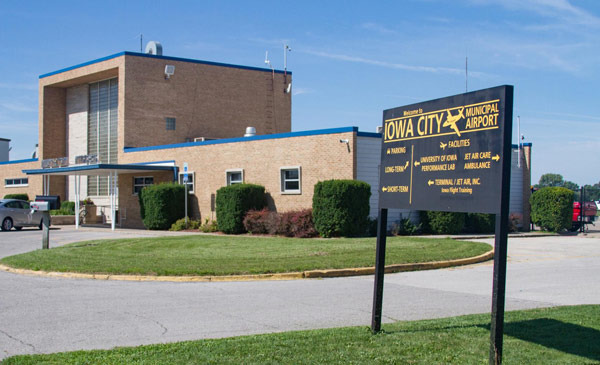
When people think of Iowa City, they usually associate it with a college atmosphere, Big Ten sports, medical schools, and large hospitals, but in fact, there is a small Iowa City Municipal Airport.
It may sound like a grand international airport just by name, but it is not a commercial passenger airport; rather, it is a small "local lifestyle airport" where regional business jets, private planes, flight training, and air ambulances operate. Although small, it plays an important role closely connected to Iowa City's ecosystem of education, healthcare, and business.
This airport is easily accessible, just a few minutes' drive south of downtown Iowa City. There is no parking hassle, and unlike large airports, there are no endless security lines. It is modest enough that you can see the runway as soon as you get out of your car, and this very structure is what makes it appealing.
In particular, medical flights linked to local hospitals frequently come and go, and since the University of Iowa Hospitals is nationally renowned, long-distance and kidney transport aircraft, emergency patient transport flights, and dedicated medical staff movements quietly take place here. While it appears calm on the surface, life-saving aviation is happening behind the scenes.
Another interesting function is flight training. This airport hosts aviation schools and flight schools, where aspiring pilots practice flying on this small runway. Therefore, on weekday afternoons or weekends, it is common to see novice pilots repeatedly landing and taking off on the runway. It is a tranquil and peaceful scene that you would never see at a large airport. Occasionally, small planes practicing landing maneuvers low to the ground give the feeling of watching a small air force training session.
Due to the airport's size, aircraft maintenance and servicing are also important industries here. Companies that own private planes or small to medium-sized jets store their aircraft here and have regular inspections done. While this area is not often visible to the general public, what appears to be ordinary hangars from the outside actually play a foundational role in the aviation maintenance industry. The reason such an airport operates in a medium-sized college town like Iowa City is that the local economy, healthcare, and research systems are so robust that there is a subtle demand for aviation.
Of course, there are drawbacks and limitations. Since there are no commercial passenger flights, it has little utility for general travelers, and noise complaints do arise occasionally. During winter snowstorms, flight training may be restricted, and small aircraft are significantly affected by strong winds. However, the airport management is continuously working to improve by adjusting flight paths to reduce noise and collaborating with the local community.
Ultimately, Iowa City Municipal Airport is not flashy or large, but it is a practical airport that perfectly fits the characteristics of a college town. It quietly performs various functions such as medical aviation, flight training, small business aviation, and aircraft maintenance, serving as a hidden transportation hub for the region. It is a good example of the saying, "A big airport is not necessarily a good airport."







 Hoorah Ooorah |
 Iowa Egen Aunt |
 Iowa School News |
 dralix58 |
  Gorama Round |
  Skydiving |
  dreamport |
  Yellow Snowman |
  Toaster Pizza Magic Show |
  velvetnom |
  Anytime Journey |
  Mrs. Duluth |
  jaxter |
  Atlanta Mama |
  Baguette Blog |
  US Embassy |
  Korean Mom |
  My NYC |
  moo moo |
  Mr Oh |
  forevergee |
  festival |
  manchester |