
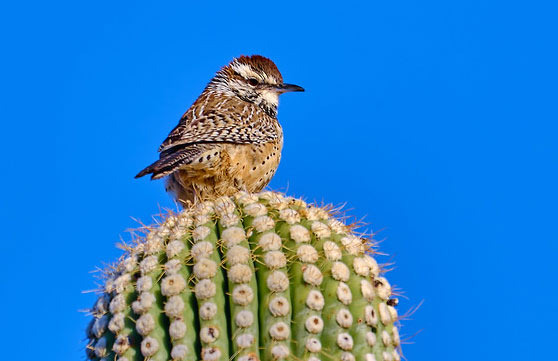
While wandering around Tucson, there's a bird that keeps catching my eye.
It's the small bird, Cactus Wren, sitting boldly on a spiky cactus and looking down at the neighborhood.
Perhaps because it's the representative bird of Arizona, it really is seen everywhere.
Whether it's a saguaro, cholla, or prickly pear cactus, it doesn't discriminate and perches at the very top of the cactus where the spikes are plentiful, making you think, "That spot seems like only you could sit there..."
It looks like a dizzying spot for humans, but from the bird's perspective, it's the best VIP seat with a view in the world. Why does it choose to sit on such a spiky cactus?
First, it's safe. Predators like snakes, coyotes, and cats can't easily climb up. It's nearly impossible for them to reach the nest with chicks through the thorny forest.
Second, the view is excellent. The desert has few places to hide and is quite open. Sitting atop a tall cactus allows it to see 360 degrees around. It can spot who is approaching, where prey is moving, and if other birds have entered its territory. It's literally a "cactus watchtower."
When you hear the name Cactus Wren, it might sound like a small forest bird, but in reality, it's quite robust. Its body is covered in dense brown and white spots, and it has a dark line running behind its eyes, giving it a somewhat distinct expression.
Its song is surprisingly loud, and its personality is quite bold. If another bird approaches the cactus it considers its territory, it won't let it be and continuously calls out as if to say, "Get lost!"
With its small body, its pride is at the level of a desert king. Its way of living is completely 'desert-style.' It readily eats insects, spiders, small bugs, seeds, and occasionally cactus fruits. Instead of searching for water, it tends to get moisture from its food, so even in the dry Tucson summer, it endures steadfastly without a drop of water.
On some days, you can even see it sneaking bites of snack crumbs dropped by people, making you think, "This bird is truly a local fixture."
The way it builds its nest is particularly interesting. Cactus Wrens nest deep within the branches of cacti, especially the densely spined cholla or saguaro. From the outside, it looks like just a mass of thorns, but up close, there's an oval-shaped nest made of grass and twigs hidden inside. The entrance is narrow, and the inside is relatively spacious, making it perfect for raising chicks. The thorns serve as a natural security system, so there's no need to build thick walls. It may seem like a dangerous place, but for this bird, it's the safest nursery in the world.
Another thing is that this bird doesn't seem to be that afraid of people. It appears near cacti in Tucson's residential areas, parks, hiking trails, and shopping mall parking lots. It keeps a certain distance when people pass by but doesn't completely flee. It's as if to say, "I know you're here, but I was living here first."
Perhaps that's why it's almost like a local mascot to the residents. You develop a habit of looking up at the cacti while walking.
By making thorny cacti its home, foraging for bugs in a waterless land, and incorporating the dangerous desert into its radar, it has truly made the desert its own. So when you see a Cactus Wren sitting on a cactus in Tucson, it's a shame to just pass by and think, "How cute."
Sometimes, I think that human life is somewhat similar to this bird's. We often miss out on what we can do in the place we are, while only looking for the best conditions.
If you ask who the true owner of the desert is, it might be more fitting to think of this bird before the giant saguaro cacti.






 Who's watching? |
 AZ Road Master |

 manchester |
  constant |
  Leapfrog Move |
  vibranto |
  Tora Tora |
  yellowbutter |
  Dolly |
  US Embassy |
  NYC saladbar |
  Finding Superfoods |
  lightyear |
  song bang |
  vexomo |
  Indiana Jones |
  meloncat |
  novapixel |
  mortrix |
  Esther 1983 |
  fortbliss |
  Moscow Kim |