
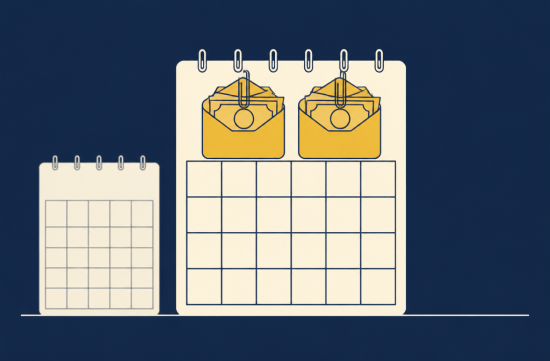
Recently, I've received similar questions from people around me. "I turned 73 this year, and I heard I can delay my first RMD until next April. Is that beneficial?"
To put it simply, you can delay it. However, you need to consider that you'll have to take two RMDs in the same year as a result.
RMD stands for Required Minimum Distribution, which is the minimum amount you must withdraw annually from tax-deferred accounts like traditional IRAs or 401(k)s. The starting age has been raised to 73 years old following SECURE 2.0.
For those born after 1960, the starting age will be 75. So, if you turn 73 in 2026, this year is your first RMD year.
According to IRS regulations, the first RMD can be taken exceptionally by April 1 of the following year. This means you can delay this year's RMD until April 1, 2027.
The issue arises afterward. Starting from the second year, the deadline is December 31, so you'll also need to withdraw the 2027 RMD by the end of that same year.
Ultimately, in 2027, you'll have to make two withdrawals: one for 2026 and one for 2027. Both amounts will be counted as income for the 2027 tax return.
Looking at the numbers helps clarify things. The RMD is calculated by dividing the balance as of December 31 of the previous year by the factor from the IRS Uniform Lifetime Table, which for age 73 is 26.5.
If the balance is $500,000, the first year's RMD would be approximately $18,868. If you delay this, the next year, this amount will be added to the second year's RMD, resulting in a significant increase in income.
There's another aspect that can be easily overlooked. The second year's RMD is based on the year-end balance, but if you delayed the first RMD, that money will still be counted as remaining in the account.
If income is concentrated in one year, it could push you into a higher federal tax bracket. There may also be an increase in the taxable portion of Social Security benefits.
You should also consider Medicare. The IRMAA surcharge on Part B and Part D premiums is determined based on income from two years prior.
If your income is concentrated in 2027, it could affect your Medicare premiums in 2029. I think this is the most regrettable aspect. You pay taxes once, but the premiums come separately.
So, is delaying always a disadvantage? Not necessarily. If you still have significant earned income this year and expect a substantial drop in income next year, delaying might actually be better.
Conversely, if your income this year and next year is similar, I would take my first RMD before December 31 of this year. Generally, it's more comfortable to spread it over two years.
For company plans, there is also a still working exception. If you continue working for the same company after turning 73, you can delay the RMD for that company's 401(k) until retirement.
However, this exception does not apply to IRAs. Owners with more than 5% of company shares are also not eligible.
If you are making donations, consider QCD as well. If you are over 70 and a half, you can have amounts sent directly from your IRA to charities counted as RMDs, and that money is excluded from taxable income.
The QCD limit for 2026 is $111,000 per person. If you are already making church donations or supporting organizations, this is a much more efficient method than writing checks from your personal account.
If you live in Massachusetts, it would be good to check state taxes as well. According to state guidance, amounts contributed to an IRA that have already been taxed at the state level are not taxed again upon withdrawal.
This is because Massachusetts did not provide state-level deductions for traditional IRA contributions. If you do not keep track of that cumulative amount, you could end up paying taxes on the same money twice.
The most critical thing to avoid is forgetting to withdraw altogether. A 25% penalty applies to the amount not withdrawn.
However, if you withdraw within the designated period and correct it with Form 5329, the penalty can be reduced to 10%. Considering it used to be 50%, this is a significant easing.
If you have multiple IRAs, you can aggregate the RMDs from each account and withdraw from any IRA. In contrast, 401(k)s must be withdrawn separately from each account, so don't get confused.
To summarize, if you are 73 this year, decide whether to take your first RMD this year or delay it until April 1 of next year.
If your income next year is not definitely lower than this year, I recommend taking it this year. If you have donation plans, handle them through QCD, and check if your company plan qualifies for the still working exception.
Tax brackets, Medicare premiums, and state taxes can vary significantly based on individual circumstances. Before making a final decision, it's advisable to consult with a tax advisor or financial professional to crunch the numbers.
At year-end, brokerage firms also receive a surge of RMD processing requests. If you've decided to take it this year, it's safer to apply early rather than waiting until the last week of December.
 GloryFish
 KeepHolding







 Conflite Teacher |
 Tainami American Travel Story |
 tarve7 |

 puddingcat |

 American Politician Community |

 nougat |

 Later Never Comes |



 Shining Our Own World |
 Raymond K. |
 gravity |
 714 Success Era Real Estate |
 Investment Beginner Company Information Encyclopedia |
 musicque |
 The Gelaton |
 ovelion |
 Chicagonian |
 Freedom Yea |
 AZ Road Master |
 glenix39 |
 Something is popping in the situation |
 orvella |
 vella |
 comets |
 Banana |
 Yes Dorian |
 Minnesota Sonata N |
 zentar |