
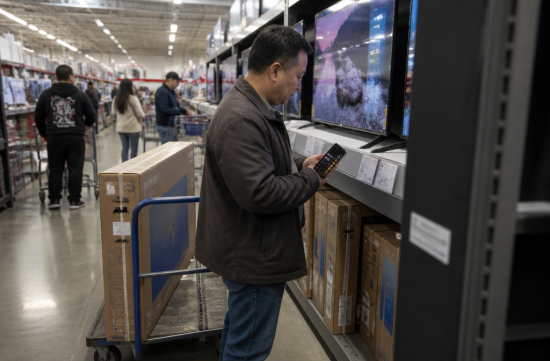
As you flip through Black Friday ads, numbers like $699 and $1,499 catch your eye. However, when you stand at the checkout, those numbers rarely reflect the final amount.
This year's Black Friday is on Friday, November 27. If you're planning to buy a big appliance, it's wise to calculate the total including tax starting now.
The sales tax in Lynnwood increased to 10.7% as of April 1 this year. This figure is also posted on the city's finance department page.
Originally at 10.6%, the city council passed a 0.1% public safety sales tax in January by a 5 to 1 vote. This increase was made without a public vote, solely by the council's decision.
The breakdown includes a state sales tax of 6.5% plus a local tax of 4.2%. Snohomish County does not have a separate county sales tax.
Reports indicate that neighboring Edmonds also raised their tax by 0.1% for transportation budgets, bringing their total to 10.7%. As a result, both cities now share the highest sales tax rate in Washington State.
A 0.1% increase might seem insignificant. In reality, for a $700 TV, the difference compared to the previous rate is only 70 cents, so it feels almost negligible.
The real issue is not just the 0.1%, but the 10.7% itself. The larger the appliance, the more significant this number becomes.
For example, let's say a TV priced at $899 drops to $699 during Black Friday.
The tax adds $74.79, making the total at checkout $773.79. That's nearly $75 more than the advertised price, so if you were planning to add a soundbar, you might need to revisit your budget.
On the bright side, if you receive a $200 discount, the tax of $21.40 on that amount is also eliminated.
This means you actually save $221.40. Keeping this in mind when considering discounts makes comparisons much more accurate.
For larger items like refrigerators, the tax adds up even more. For a $1,499 appliance, the tax alone is $160.39, bringing the total to $1,659.39.
If you buy a washer and dryer set, the total increases, and so does the tax. Remember that for every $1,000, you can expect an additional $107 in tax to make mental calculations easier.
But that's not all. Many people overlook that shipping costs are also subject to tax.
According to Washington State's Department of Revenue, even if shipping costs are listed separately, they are considered part of the sale price. If the item is taxable, sales tax applies to the shipping fee as well.
The same goes for extended warranties. Since July 2005, Washington has classified extended warranties sold to consumers as taxable retail transactions.
So, when you add shipping, installation, and warranty costs to a $1,499 refrigerator, the taxable amount increases significantly. It's wise to evaluate each option before adding items to your cart. When you receive your receipt, check each line to see where tax has been applied.
Mail-in rebates can also be misleading. At checkout, tax is applied to the price before the rebate, and the money is returned separately later.
So even if there's a $100 rebate, the amount charged to your card that day remains unchanged. If you miss the application deadline, that money simply disappears.
What about online orders? Washington applies sales tax based on the shipping address, so if you have it delivered to your home, the tax rate for that address applies.
Whether you shop at Alderwood Mall or order online for home delivery, the tax rate remains the same at 10.7%. Therefore, it's more realistic to compare prices and benefits rather than trying to avoid tax.
Some might suggest going to Oregon, where there is no sales tax. Honestly, I've considered that too.
However, Washington's Department of Revenue clearly states that items purchased in Oregon for use in Washington are subject to use tax. The tax rate is based on where the item is first used.
You can report use tax online through My DOR or via a consumer use tax return. Considering gas prices and round-trip time, it doesn't always result in significant savings.
There are also special taxing districts that may affect the rate. The most reliable way to confirm the exact rate is to check the address-specific rate lookup on the Department of Revenue's website.
My method is simple. I multiply the advertised price by 1.107 and jot it down in my phone notes, adding shipping and warranty costs separately in the next line.
When comparing prices from two stores, aligning them with tax-inclusive amounts prevents confusion. It's even better to note whether shipping is free.
And I always ask myself if the item is truly necessary. When excited about discounts, it's easy to forget the total amount with tax in mind.
While the tax increase is unfortunate, understanding that it's for public safety makes it somewhat reasonable. Ultimately, consumers have no choice but to keep track of every line on their receipts.
If it were me, I would compare only the total amounts including tax this Black Friday, as that figure represents the actual money leaving my wallet.
 JellyJoy
 ColaBoatCrew


 choi family |

 content |

 Carolina border |

 Que Buena |
 juicylol |

 crystalx |
 kingdom |

 compass |

 harvest |

 strawberry |
 US Regional Information Local News |
 USA Business News |
 Blondee |
 E whisper |
 Potato House |
 freshmint |
 Ansaso |
 Golado |
 babybay |
 honeycom |
 French Macarons |
 Exploring American Life Information |
 Sunshine Blog |
 Community Cross |
 Sayonara H |
 What can make money? |
 Information Search LifeMAN |
 morvex37 |
 neontrail |