

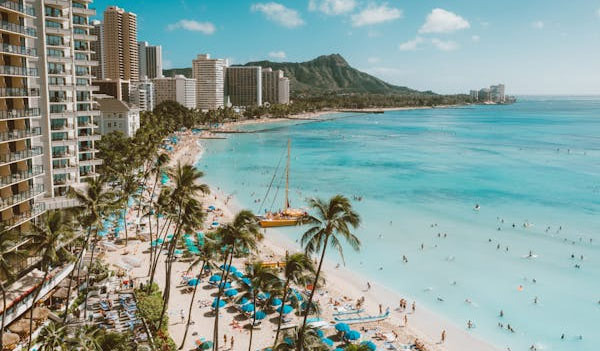
When you go to Hawaii, you will often meet Korean people everywhere. In addition to the tourists who come year-round, there is also a significant Korean community that has established roots and lives locally.
The current estimated Korean population in the state of Hawaii is about 40,000 to 60,000, and the Korean community in the Honolulu area, including mixed-race individuals, is known to be around 27,000.
According to data released by the Overseas Koreans Agency, the number of overseas Koreans residing in Hawaii is counted at 61,898, which may vary based on statistical criteria.
One of the most notable characteristics of the Korean community in Hawaii is its long history. Unlike many Korean communities on the mainland U.S. that rapidly grew after the 1970s, Korean immigration to Hawaii began in 1903 during the Korean Empire. At that time, thousands of Koreans came to Hawaii to work on sugarcane plantations, and these individuals became the roots of today's Korean community in Hawaii. When discussing the history of Korean immigration in the U.S., Hawaii is essentially regarded as the starting point.
Due to this historical background, the Korean community in Hawaii has a very high percentage of citizens. According to the Overseas Koreans Agency, among the 61,898 Koreans in Hawaii, 43,434 are citizens, making up about 70%. This is significantly higher than in other regions of the U.S.
The reason is that the first generation who immigrated to the U.S. over 100 years ago and their descendants have long settled in Hawaii and obtained U.S. citizenship. This structure is different from cities that are primarily composed of recently migrated students or employment immigrants.
The main industries in which Koreans are engaged also reflect Hawaii's unique characteristics. The most common industries are restaurants, supermarkets, and tourism-related services. Due to the area's high tourist traffic, Korean restaurants, cafes, souvenir shops, and travel agencies are consistently in operation. Additionally, Koreans are actively involved in real estate, insurance, accounting, beauty salons, nail shops, and medical services. Recently, there are also a considerable number of Koreans working in the hotel and resort industries.
Honolulu does not have a large Koreatown like LA or New York. However, the Keeaumoku Street area effectively serves as the Korean commercial district. This area is densely populated with Korean restaurants, cafes, beauty salons, hospitals, real estate offices, and travel agencies, and it is home to one of Hawaii's largest Korean supermarkets, Palama Market. It is a frequent destination for local Koreans as well as Korean tourists.
The Korean language environment allows for daily life in Korean supermarkets and restaurants, and some hospitals, real estate offices, and insurance offices also provide services in Korean. Especially with a high percentage of first-generation immigrants, the use of Korean is actively maintained around churches and temples. However, similar to other regions in the U.S., the younger generation is increasingly using English.
Korean churches and temples still play a central role in the community. They connect the local community through religious activities, support for immigrant settlement, elderly welfare, cultural events, and scholarship programs. Additionally, the Korean Association and various cultural organizations operate traditional Korean cultural events and Korean language education programs to promote Korean culture.
Recently, the popularity of K-pop, Korean dramas, and Korean food has increased the influence of the Korean community. In the past, the Korean community often operated internally, but now local residents and tourists actively participate in Korean restaurants and cultural events, establishing themselves as important cultural members of the community.
In terms of size, it may seem smaller compared to LA, New York, Atlanta, or Dallas. However, the Korean community in Hawaii is a unique community with symbolic significance as the starting point of Korean immigration history in the U.S., a high percentage of citizens, and a strong sense of community.
For over 100 years, Koreans deeply rooted in Hawaiian society continue to play an important role in the local economy and cultural development today.
 PastaDriveSim
 StillLiving
 PuddingBear
 FoggyBrain



 moo moo |
 ultron78 |
 garlic bread |
 Sugar Cream Door Bulletproof Noodles |
 urbanmint |
 HAWAII Korean Church News |
 victoria 68 |
 Hawaii Tourist Information |

 TEX MEX STAR |
  road98 |
  Churros Train Conductor |
  gleeful |
  Burbank Lee |
  Olivia's Blog |
  Bushing Around Life |
  Active |
  Cherokee Rose |
  Kor. Master |
  Holey Moley |
  Conflite Teacher |
  Hodong Prince Over Flex |
  Mist inn |
  citrus pop |
  Onion Ring |
  phoenixia |
  viewtop |
  loverun |
  Kim Do Sun |
  SEVEN SEVEN |