

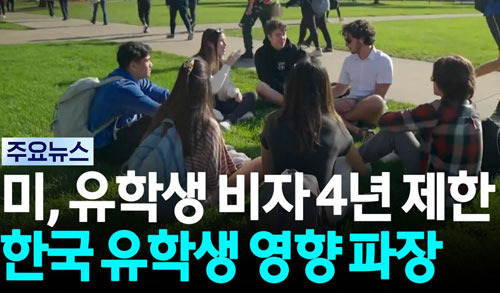
Oh dear, those preparing to study in the U.S. must be feeling a bit overwhelmed by this news.
Having lived in California for a long time, I've seen many international students come and settle in the U.S.
So, when I heard about the changes to the student visa regulations, I thought it would become more difficult for students to settle in the U.S. on a student visa.
In the past, if you received a student visa (F-1), you were subject to a 'D/S (Duration of Status)' rule.
Simply put, as long as you remained enrolled and were studying normally, you could stay in the U.S. until you completed your studies.
Some students would finish their bachelor's degree and continue on to a master's program, or pursue research, and some even changed their majors if needed.
Of course, not everyone did this, but it is true that students could plan relatively flexibly according to their academic schedules.
However, now the duration of stay on a student visa is generally set to 4 years, and after that, extensions will need to be applied for.
You might think, "Isn't 4 years enough to graduate from college?"
But in reality, that's not always the case. A prime example is doctoral programs.
In the U.S., doctoral programs often take about 5 to 7 years depending on the research schedule, and in some fields, it can take even longer.
These students may now have to go through the extension process even if they haven't completed their studies.
Students changing their majors may also need to be more cautious.
It's relatively common for students to find their strengths and change majors after enrolling in U.S. universities, but this aspect may be more affected than before.
International students living in the U.S. with their families are in the same boat.
This isn't just an issue for the student; when a spouse and children are involved, the visa timeline is closely tied to the family's living plans.
So, moving forward, it seems that both academic and family plans will need to be prepared more long-term.
There are analyses suggesting that U.S. universities could also be significantly impacted.
International student tuition often makes up a significant portion of university finances.
If international students start choosing countries like Canada, the UK, or Australia over the U.S., universities may face greater challenges.
Of course, there's no need to worry excessively.
After 4 years, you won't necessarily have to leave the U.S.; you can apply for an extension if needed.
However, the biggest change is that instead of a structure where staying is automatic as long as you continue your studies, there will now be a requirement for extension reviews.
Honestly, just from what I know of people, it's true that uncertainty has increased for international students compared to before.
In the future, not only will choosing a school become more complicated, but graduation timing, plans for graduate school, and job preparation will all become more complex.
 HamsterShire
 KoreaForever







 Make My Day |
 viroma |
 eatontown blog |
 Toaster Pizza Magic Show |
 US Embassy |
 Famous Attractions in the United States |


 Finding Superfoods |
 U.S. Military Recruitment Information |
  road98 |
  Churros Train Conductor |
  gleeful |
  Burbank Lee |
  Olivia's Blog |
  Bushing Around Life |
  Active |
  Cherokee Rose |
  Kor. Master |
  Holey Moley |
  Conflite Teacher |
  Hodong Prince Over Flex |
  Mist inn |
  citrus pop |
  Onion Ring |
  phoenixia |
  viewtop |
  loverun |
  Kim Do Sun |
  SEVEN SEVEN |