

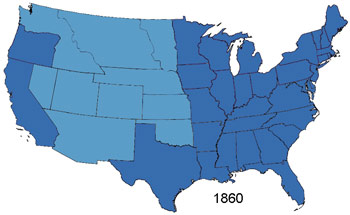
After the conclusion of the Civil War, which lasted from 1861 to 1865, the power bases of the Republican and Democratic parties began to be restructured regionally. At that time, the Republican Party clearly represented the North, while the Democratic Party represented the South. This is quite different from today.
The North developed as an industrial center, solidifying support for the Republican Party, while the defeated South suffered significant political wounds under the interference of Northern troops and administration during the Reconstruction period. However, with the official end of Reconstruction in 1877, the South began to establish its own political power again, and local governments centered around white Democrats started to take root.
Although slavery was abolished, the voting rights of Black people were effectively blocked, leading to the entire South becoming dominated by the Democratic Party for a long time, giving rise to the term 'Solid South.' During the Great Depression of the 1930s, President Franklin Roosevelt expanded the Democratic Party's base significantly with his New Deal policies. Workers, farmers, and urban poor supported the Democratic Party, and its support base expanded to the Northeast and Midwest.
However, at the same time, the Black civil rights movement intensified, leading to growing conflicts between Southern white conservatives and the Democratic Party. In the 1960s, when the Democratic Party actively supported Black civil rights and passed civil rights legislation, Southern whites turned away, and the Republican Party seized the opportunity.
Richard Nixon implemented the 'Southern Strategy' to absorb that voter base, and by the time of Ronald Reagan, the South had completely transformed into a Republican stronghold. Thus, the South, which was once centered around the Democratic Party, has become a core support area for the Republican Party today, known as 'Red States,' while the Northeast and large urban areas on the West Coast have solidified as 'Blue States.'
Of course, this structure is not completely fixed. In regions like Texas and Georgia, where the influx of younger generations and urbanization is rapid, the political landscape is gradually changing.
Additionally, in the Rust Belt region of the Midwest, the Republican Party is drawing back the working class, encroaching on the former Democratic support base.
Ultimately, the structure of American political parties is not simply a result of the outcome of the Civil War, but rather a complex interplay of social changes, human rights issues, economic structures, and population movements over time that has shaped its current form.







 Magic Cabbage School of Martial Arts |
 Vacation on Hawaii |
 morvex37 |
 Ari Songhan American Immigration Life |
 Bearded Strawberry Smoothie |
 Chino Min |

 DREAM BIG |
 Information on All Regions of the United States |
 Korean Mom |
  My NYC |
  moo moo |
  Mr Oh |
  forevergee |
  festival |
  manchester |
  constant |
  Leapfrog Move |
  vibranto |
  Tora Tora |
  yellowbutter |
  Dolly |
  US Embassy |
  NYC saladbar |
  Finding Superfoods |
  lightyear |
  song bang |
  vexomo |
  Indiana Jones |