
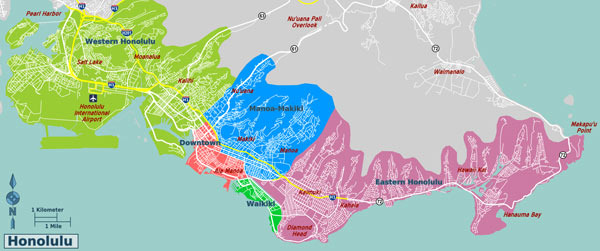
While living in Hawaii, I thought of Honolulu as just one city. I assumed that Waikiki had its own city hall, and Kapolei had its own too. But as I looked into it, I was surprised to find out, "Oh? That's not the case!"
It turns out that the entire island of Oahu is managed as a single administrative region called the 'City and County of Honolulu.'
In simple terms, whether you live in Waikiki, Kapolei, or the North Shore, all administrative matters are handled by the same Honolulu city hall. I found it fascinating that such a structure is not common in the U.S.
You don't see this kind of setup on the mainland. Just look at Texas: Houston has its own city hall, Dallas has its own, and San Antonio has another. But in Hawaii, the entire island operates as one city, so when I learned about it, I thought, "Wow, I didn't know places like this existed!"
This administrative system was established in 1907. Given the clear natural boundaries of Oahu, it was deemed much more efficient to operate as one rather than having multiple city governments. Today, about 1 million residents living on Oahu all receive administrative services from the same city government.
When you think about it, this seems quite reasonable. Although the island is large, it's not like a mainland city where urban areas stretch endlessly. The Honolulu city hall manages road maintenance, parks, garbage collection, operates TheBus, and handles administrative tasks like building permits.
However, it's not just one mayor making all the decisions. There is also a Honolulu city council that represents the residents. Oahu is divided into 9 districts, and each district elects one council member, totaling 9 council members. They serve to convey the opinions of residents from areas like Kahala, Diamond Head, Manoa, Makiki, Downtown, Chinatown, Kapolei, and the North Shore.
The areas around Keaumoku and Ala Moana, where many Koreans live, are also where the district council members are active. While politics may seem distant at times, issues that directly affect our lives, like road construction, park maintenance, bus routes, parking issues, and homelessness policies, are mostly discussed in the city council.
Another interesting aspect I noticed was community participation. The Honolulu city council holds open meetings, allowing residents to attend public hearings or submit opinions. It seems that this kind of engagement is quite active in the U.S. In fact, there are many instances where resident opinions are reflected in local development or transportation issues.
Additionally, there is a separate Hawaii state legislature that governs the entire state of Hawaii. Major policies regarding education, taxes, and tourism are handled at the state level, and above that, there are elections for federal senators and representatives, which reinforces the multi-layered nature of American politics.
In the past, when I visited Hawaii, I would only focus on the beaches and finding good restaurants, but these days, I find myself curious about how the city operates. Walking through Waikiki again, I realized it's not just a tourist spot but a massive city where about 1 million people live together.
I only knew that Hawaii was a place of natural beauty, but I learned for the first time about its unique administrative structure. Knowing these kinds of stories about a place before visiting can greatly enhance the experience of exploring it.
 TemuBoss
 PizzaHut234
 OutsideCity






 eatontown blog |
 Toaster Pizza Magic Show |
 US Embassy |
 fortbliss |
 Folding Instructions |
 victoria 68 |
 Hawaii Tourist Information |
 HAWAII Korean Church News |

 TEX MEX STAR |
  Tonky |
  viroma |
  cookie |
  Live and that's it |
  Alright Twain |
  Amore |
  linex |
  Balancework |
  laro90 |
  MEDBIO American Doctor Blog |
  SWAT TEAM BLK |
  DREAM BIG |
  frostbite |
  330 Forever My Love |
  El Dorado |
  dralix58 |
  Gorama Round |
  Skydiving |