

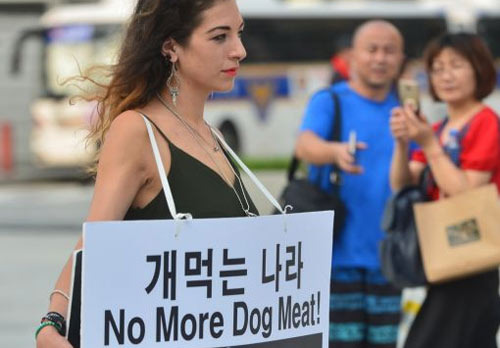
Oh my, dog meat? That's illegal now~
Living in San Diego, I often talk about Korea with my American friends.
When the topic of food comes up, their eyes light up. Kimchi? They love it. Pork belly? They go crazy for it. When I wrap it in lettuce and give them a bite, they really enjoy it.
But there's always that one question that comes up.
"Do people really eat dog meat in Korea?"
Oh man. At that moment, the atmosphere freezes. I'm just standing there holding the tongs I was using to grill pork belly, completely stunned.
I've never even seen dog meat in my life, so why am I the one explaining this?
"I don't eat it~" And then they say, "But that culture exists in Korea, right?"
Why do they say that to me? I'm just a lady who loves kimchi stew.
But here's the thing
I saw in the news that starting next year, dog consumption will be banned by law in Korea.
From February 7, 2027, it will be illegal to raise, slaughter, distribute, or sell dogs for consumption.
Wow, this is big news.
So when my American friend asks again, what will I say?
It won't just end with "I don't eat it~"; I can say, "Hey, it's illegal in Korea now."
Just that one sentence. I can't tell you how reassuring that is.
But it's not just about making a law
First, I did some research and found out that there are 5,898 related businesses, including dog farms, slaughterhouses, distributors, and restaurants.Wow, I thought there would be a few hundred, but there are over six thousand establishments.
Just saying, "Close your doors starting tomorrow" isn't going to work, right? It won't.
So the government is providing support to the farmers who have to close down.
The earlier they close, the more money they get. Oh, they really understand human psychology.
In next year's budget, there's a fund of 56.2 billion won for business closure incentives and 30.5 billion won for the remaining value of the facilities owned by the farmers.
All of this adds up to a total of 109.5 billion won, with half covered by national funds and half by local funds.
In Korea, people are now raising dogs as part of the family. Not just family, but as a beloved member.Do you know what their names are? Kim Coco, Park Choco. They even add surnames. They send them to kindergarten and prepare birthday feasts. I can't even remember my own birthday.
Living in America, I feel this even more. When you go to parks or beaches in San Diego, you hardly see anyone without a dog.
There are water bowls placed in front of cafes, and there are even dog-friendly beaches.
I really hope that the old image of Korea changes.
Honestly, most Koreans don't eat dog meat.
Most young people have never tried it, and when you ask them, they say, "What's that?"
But this image hasn't disappeared overseas. It's almost common knowledge that Koreans eat dog meat.
Now, if someone asks, "Do Koreans still eat dogs?" I will say this.
"There used to be that culture, but now it's banned by law."
This change might be remembered as a moment when Korea has matured a step further, and I, the San Diego lady, have high hopes for it~ ShareDonkey
 SnowLove







 Korean Mom |
 novapixel |
 Peter Pan Pet |
 horse |
 Sunset Oregon |
 U.S. Supreme Court Judge Kim |
 Egg Steamed Pot |
 Learn English Accurately |
 Magic Cabbage School of Martial Arts |
 Peach Jam Eating Laughter |
  US Embassy |
  My NYC |
  moo moo |
  Mr Oh |
  forevergee |
  festival |
  manchester |
  constant |
  Leapfrog Move |
  vibranto |
  Tora Tora |
  yellowbutter |
  Dolly |
  NYC saladbar |
  Finding Superfoods |
  lightyear |
  song bang |
  vexomo |
  Indiana Jones |