

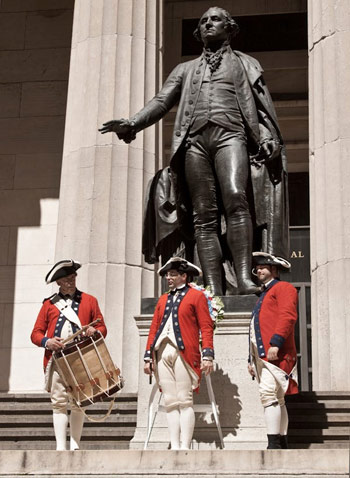
The story of the American Revolutionary War is quite famous and serves as an interesting starting point to examine how the United States was born.
From a textbook perspective, it can be simply summarized as a war that lasted from 1775 to 1783, where the British colonies declared, "We are going to be independent!" However, if you dig a little deeper into the background, you'll find that it is a very complex and diverse web of events.
The Atmosphere Before the War
In fact, until the early to mid-1700s, the 13 British colonies on the North American continent were living relatively peacefully under the protection of the British crown. However, after the Seven Years' War (French and Indian War) ended, Britain began to impose taxes on the colonies to cover the war costs. Various laws, such as the Sugar Act and the Stamp Act, were enacted, leading the colonists to protest, "Why are you imposing taxes without our parliamentary representation?" This gave rise to the slogan "No taxation without representation."
The Boston Tea Party Incident
As British taxation policies and regulations piled up, a very symbolic event occurred in Boston in 1773. The colonists dumped tea from the British East India Company's ships into Boston Harbor. This caused an uproar in the British government, leading them to tighten their grip on the colonists. Such coercive policies only fueled discontent and ignited the flames of independence.
The Outbreak of War and Initial Situations
With the battles of Lexington and Concord in 1775, the atmosphere shifted to "Now it's war." The Continental Army began to organize under George Washington as their commander-in-chief. Although they were initially poorly equipped and organized, the British army underestimated them and faced unexpected resistance. Support from various European countries, including France, gradually began to arrive, fulfilling the hope that "countries not on good terms with Britain would provide assistance."
The Declaration of Independence, That Great Declaration
On July 4, 1776, the so-called 'Declaration of Independence' was announced in Philadelphia. Drafted under Thomas Jefferson's leadership, this document stated that all men are created equal and have the right to pursue liberty and happiness, which became the foundation of American democracy. It is still the first document that comes to mind when tracing back to the founding ideals of the United States.
The War Expanded with France's Involvement
Initially, the Continental Army faced many difficulties when confronting the British regular army. Remembering the harsh winter and lack of supplies during the famous winter training at Valley Forge, they endured numerous hardships. However, when France officially entered the war in 1778, the tide turned. The French navy helped to contain the British fleet in the Atlantic, and with financial and military support, the Continental Army found it much easier to fight.
The Battle of Yorktown and the End of the War
The back-and-forth war came to a head in 1781 when the British army suffered a decisive defeat at the Battle of Yorktown. Both sides were exhausted from the war, and criticism of the prolonged conflict grew within Britain, leading to the official end of the war through the Treaty of Paris in 1783. This treaty recognized the independence of the 13 colonies, officially introducing the nation of "America" to the international community.
The Legacy of the War
The American Revolutionary War was not just an event of driving out the British and creating a new nation; it also served as a catalyst for spreading the desire for "republicanism" and "freedom, equality, and human rights" worldwide.
It is said to have had a significant impact on the French Revolution and the independence movements of various South American countries.
Of course, at the time of independence, the United States faced numerous issues, such as the problem of black slavery, conflicts with Native Americans, and issues of regional decentralization. However, historically, it holds great significance in that it opened the path toward autonomy and freedom through "independence."
In summary, the American Revolutionary War began with the cry against "taxation without representation" and led to a confrontation with Britain across the Atlantic, but the background is much more complex and multifaceted. Ultimately, the 13 colonies united to overcome Britain, laying the groundwork for modern democracy.
While one might see it as a brief account of "the Declaration of Independence in 1776, followed by the end of the war" when reading history books, the deeper you look, the more you'll realize, "Ah, independence was not simply a fruit that fell easily from the tree." It was born through a tumultuous era filled with blood, sweat, various adventures, and political strategies, and remembering this will be fascinating.






 Magic Cabbage School of Martial Arts |
 Vacation on Hawaii |
 morvex37 |
 Ari Songhan American Immigration Life |
 Bearded Strawberry Smoothie |
 Chino Min |
 Information on All Regions of the United States |

 DREAM BIG |
 Tonky |
  viroma |
  cookie |
  Live and that's it |
  Alright Twain |
  eatontown blog |
  HAWAII Korean Church News |
  Amore |
  linex |
  Balancework |
  laro90 |
  MEDBIO American Doctor Blog |
  SWAT TEAM BLK |
  frostbite |
  330 Forever My Love |
  El Dorado |
  dralix58 |
  Gorama Round |
  Skydiving |