
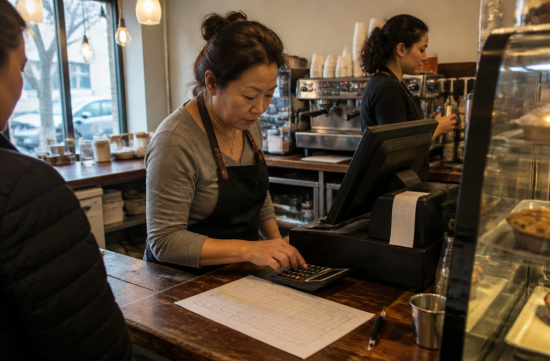
The owner of my favorite café was tapping away at the register. When I asked what he was doing while getting my coffee, he sighed and replied, "I'm calculating next year's labor costs."
Curious, I looked it up when I got home. According to the New Jersey Department of Labor, starting January 1, 2027, the minimum wage for most workers will rise to $16.48 per hour.
That's an increase of 56 cents from this year's $15.92. The structure is designed to adjust automatically each year based on inflation, so it's not a politically driven increase.
Fifty-six cents might not seem like much at first. I initially thought it was about the cost of half a can of soda from a vending machine.
However, when calculated for full-time work, it adds up. With 40 hours a week for 52 weeks, that totals 2,080 hours in a year.
Multiplying 2,080 hours by $16.48 gives an annual salary of $34,278.40 for one employee. This year's figure was $33,113.60, meaning an increase of $1,164.80 per employee.
But that's not all. Employers also pay an additional 7.65% of wages for Social Security and Medicare.
Adding that 7.65% to the $1,164.80 means an extra burden of $1,253.91 per employee. Considering state payroll taxes like unemployment insurance, the total cost increases further.
For a restaurant in Fort Lee with about five full-time equivalent employees, that means an additional $5,824 in wages annually.
For businesses that primarily hire part-time workers, the calculation is similar. Two part-time employees working 20 hours a week will result in nearly the same increase as one full-time employee.
Now I understand why the owner was calculating. Even if you break it down monthly, that's nearly $500.
Interestingly, small businesses with fewer than six employees and seasonal businesses have a different phased schedule.
For them, the wage will rise from $15.23 to $16.25 next year, a significant increase of $1.02. That's almost double the general increase.
For full-time workers, that translates to an additional $2,121.60 per employee annually. Owners of small local businesses like rice cake shops or nail salons may feel this impact even more.
This small business schedule is designed to catch up with the general minimum wage by 2028. So, it means another significant increase is expected in 2028.
We can't forget about tipped employees either. The minimum cash wage for restaurant servers will rise from $6.05 to $6.61.
The tip credit cap remains at $9.87. Adding $6.61 to $9.87 equals exactly $16.48.
This means if a server's total earnings, including tips, do not reach $16.48 on a given day, the employer must make up the difference. This regulation becomes quite real on rainy weekdays when customers drop off.
Agricultural workers will see an increase from $14.20 to $15, while direct care staff in long-term care facilities will earn $19.48. These figures may be a bit distant from our area, but I mention them for reference.
Overtime calculations will also change. At 1.5 times the rate, that comes to $24.72 per hour.
If customers are busy on weekends and you keep staff an extra hour, those hours add up. I recommend keeping this number handy when scheduling.
So how should business owners prepare? First, since the new wage will take effect with the first paycheck in January, you need to adjust your payroll software before the end of the year.
If your business has around six employees, make sure to verify which criteria apply to you. If unsure, checking the New Jersey Department of Labor's wage and hour resources or consulting an accountant is the quickest way to clarify.
You might also be considering whether to raise menu prices. Whether to increase the price of a bowl of galbitang by $1 or adjust working hours will vary for each business in terms of customer retention.
Employees also have responsibilities. Make sure to check that the new hourly wage is accurately reflected in the first paycheck of January.
During the busy early months of the year, it's easy to overlook mistakes that result in old wage rates being used. This is especially true for small businesses that calculate payroll manually. Even if it feels awkward to bring it up, this is something that must be addressed.
Honestly, I feel both relieved and concerned about this increase. It's not easy to survive on a wage in the $15 range in Fort Lee.
However, we can't ignore the burden on business owners either. With rent and material costs rising, labor costs are compounding the issue.
Ultimately, this 56-cent increase will have to be shared among customers, business owners, and employees. A situation where only one side suffers won't last long.
Still, I think a predictable annual increase based on inflation is a good approach. It's much better than sudden jumps of several dollars, as it allows for better planning.
The next time I visit that café, I'll have to leave a slightly larger tip. The image of the owner tapping away at the register keeps coming to mind.
 Castle99
 IronSquid



 Exploring American Life Information |

 Franco Family |

 Home Run King Byeon Seung-yeop Blog |
 mistic |

 Hodong Prince Over Flex |

 The Yellow |

 La Bean |



 clouds 09 |

 Shining Our Own World |
 Raymond K. |
 gravity |
 714 Success Era Real Estate |
 Investment Beginner Company Information Encyclopedia |
 musicque |
 The Gelaton |
 ovelion |
 Chicagonian |
 Freedom Yea |
 AZ Road Master |
 glenix39 |
 Something is popping in the situation |
 orvella |
 vella |
 comets |
 Banana |
 Yes Dorian |
 Minnesota Sonata N |
 zentar |