

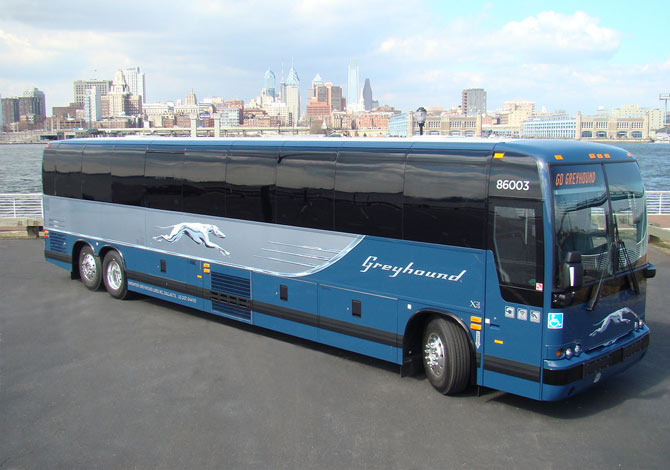
The name that comes to mind when thinking of buses crossing the United States is Greyhound.
Korean Americans in Philadelphia often took this bus during the early years of immigration, traveling not only throughout the East but also to Florida.
However, looking back at the past 50 years of this company reveals quite a bit of drama. It feels like an old veteran struggling to survive on the road.
1970s-80s: Once a King
In the past, it truly dominated the nation. People without cars, students, soldiers, immigrants, and travelers all rode Greyhound. It was cheaper than trains and flights were expensive. But as cars became more popular and airfare started to drop, warning signs began to appear. By the 1980s, major strikes occurred, and the company began cutting routes to survive. The bus, once called the "dog on the road," faced a period of shedding its fur.
1990s-2000s: Enduring and Enduring
During this time, the company merged, competed, and struggled to survive. However, the emergence of low-cost "Chinatown buses" in the Northeast complicated matters. With fares less than half, they offered direct routes like New York-Philadelphia-Boston, making it easy for people to switch. Greyhound began selling some terminals and reducing routes, adopting a "core only" strategy. It felt like a large corporation was gradually shrinking.
2010s: Let's Revamp
Suddenly, a transformation attempt began. New buses were introduced, Wi-Fi was added, outlets were installed, ticketing was made available through an app, and a faster, cleaner route called "Greyhound Express" was created. The company also worked hard on advertising to change its image. In short, it was a time when they shouted, "We're not the old bus anymore; we're more sophisticated!"
2020s: The Pandemic
Then COVID-19 hit. Long-distance travel nearly disappeared, and bus companies were hit hard. Greyhound began selling terminals or moving them to the outskirts, changing its operating methods to survive again. Recently, it has been preparing for another transformation after being acquired by another global transportation company. Now, it is becoming part of a larger platform that bundles various mobility services rather than just being a "bus company."
In fact, Greyhound Lines has been a recipient of various government subsidies and support programs. Especially for rural areas or routes with low passenger numbers, which are at risk of disappearing due to low profitability, federal and state "public transportation subsidies" have played a significant role in maintaining these routes.
For example, the Federal Transit Administration (FTA) and state transportation departments have supported bus operating costs, terminal maintenance, and route reestablishment, allowing Greyhound to avoid complete collapse. Additionally, during the pandemic, the federal government helped long-distance bus companies like Greyhound survive when they had to temporarily suspend or significantly reduce operations through public transit operating fund support.
As a result, this company has maintained a certain "public role" amid market competition, which also shows that it would have been difficult to survive without government assistance. Greyhound has endured despite the massive waves of passenger car proliferation, airfare, low-cost buses, the pandemic, and digital innovation. Thus, this bus, which you might subtly see on the road while traveling in America, feels like more than just a means of transportation; it represents an American survival story.
Will it continue to run in the future? Probably so. It seems that Greyhound is demonstrating that the ability to continuously transform is a skill.






 candytip |
 Gold Bar |
 Pirate Ship Popcorn Maker |
 Montgomery Mom |
 Anjollinya Blog |
 DelphiaMo |
 blueman |
 positive x |

 bubblo |
  manchester |
  constant |
  Leapfrog Move |
  vibranto |
  Tora Tora |
  yellowbutter |
  Dolly |
  US Embassy |
  NYC saladbar |
  Finding Superfoods |
  lightyear |
  song bang |
  vexomo |
  Indiana Jones |
  meloncat |
  novapixel |
  mortrix |
  Esther 1983 |
  fortbliss |
  Moscow Kim |