

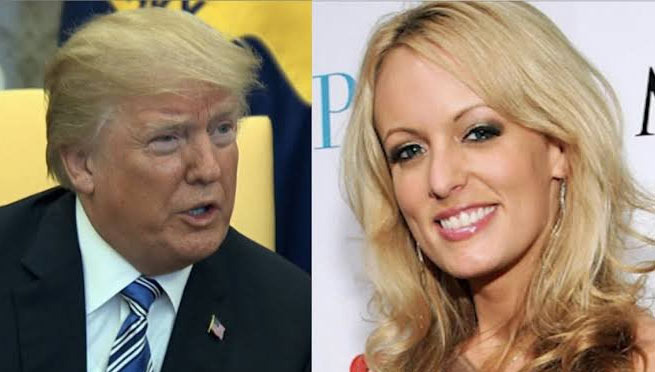
President Donald Trump's so-called 'hush money case involving Stormy Daniels' has once again come under judicial review.
This time, the key issue was not a determination of guilt or innocence, but whether the case, which has already been found guilty in a New York state court, could be moved to federal court.
To conclude, the federal court ruled that it could not be moved.
Those unfamiliar with the case may find it a bit confusing. In the U.S., there are primarily state courts and federal courts.
State courts mainly handle cases related to the laws of each state, like New York, while federal courts deal with issues related to federal law or the U.S. Constitution.
Trump was found guilty on all 34 counts of falsifying business records in Manhattan, New York, in 2024.
The case originated from a payment of $130,000 made to adult film actress Stormy Daniels before the 2016 presidential election.
The prosecution argued that the reimbursement costs related to this payment were recorded as legal expenses in the company's books, and the jury sided with the prosecution.
Trump was subsequently sentenced to an 'unconditional discharge,' meaning he would not serve jail time or receive probation, but the guilty verdict remains.
However, Trump's team sought to move the case from New York state court to federal court. One of the significant reasons was Presidential Immunity. They aimed to leverage a 2024 Supreme Court ruling that broadly protects a president from criminal liability for actions taken in an official capacity.
But on August 28, Judge Alvin Hellerstein of the Southern District of New York again rejected this request.
The judge's reasoning is quite straightforward. The payment to Stormy Daniels and the attempt to prevent the disclosure of the affair are not considered official presidential duties but rather personal matters. Therefore, it is difficult to apply the same immunity that would cover official acts performed in the course of foreign affairs, national defense, or administrative duties.
There were also procedural issues. Trump's team filed the request to move the case to federal court too late.
Bringing a case to federal court after a jury has already rendered a guilty verdict and sentencing has occurred is legally challenging.
That said, the case is not entirely over. Trump's team has immediately appealed this decision.
The defense argues that considering the Supreme Court's ruling on presidential immunity and the Constitution, the case should be handled in federal court, and the guilty verdict should be overturned.
Simultaneously, an appeal regarding the existing guilty verdict is also underway in New York state court.
From a Korean perspective, one might wonder, "Why is there still a trial after a guilty verdict?" In the U.S., a first-instance ruling does not conclude all legal proceedings. An appellate court can re-examine whether there were issues with the application of the law or the trial process, and if constitutional issues are involved, it may ultimately reach the Supreme Court.
Ultimately, the crux of this decision is not to reassess whether Trump is guilty or not.
It is about whether the case can be removed from New York state court to federal court, and the federal judge has once again ruled that it cannot.
Since Trump's team intends to continue fighting, it is difficult to say that this case is over.
How the appeals process in New York state and federal court unfolds will be the next point of interest.
 Cheeseball







 coloradoman |
 Montgomery Mom |
 GOGO SING |
 Hajiwon Blog Hair Salon |
 tartbear |
 cathywhite |
 dictionary |
 Nanana Nanana Nanana |
 ollege Mom |
  Esther 1983 |
  Arizona AZ Cowboy |
  fortbliss |
  Moscow Kim |
  My Two Way |
  toastyfox |
  FLORIDA Acus |
  tracker |
  TONTON COFFEE |
  sunrise |
  ultron78 |
  uplifted |
  Folding Instructions |
  same same life |
  USA Hyundai Kia |
  morvex37 |
  BOL SA RAM |
  TOUCHE NEWS |
  Small Business Information USA |