
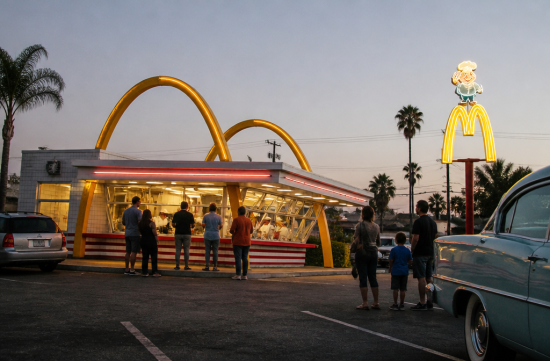
There's a place where you can grab a burger and learn some history at the same time. It's the McDonald's in Downey, located at the corner of Lakewood Boulevard and Florence Avenue.
The sign is different from others. A little chef wearing a hat stands on top of the yellow arches, and this character's name is Speedee. He is the original mascot, predating Ronald McDonald.
This location opened on August 18, 1953. It is considered the oldest operating McDonald's in the world, serving burgers for over 70 years—quite impressive, right?
The original owners were Roger Williams and Bud Landon. They received their franchise directly from the McDonald brothers, Dick and Mac, not Ray Kroc.
This is where many people get confused. The person who created McDonald's was not Kroc, but the brothers who ran a restaurant in San Bernardino. Kroc bought the company from the brothers for $2.7 million in 1961.
So, the Downey location is a product of the era before Kroc, when the brothers were directly granting franchises. This aspect became the key to the store's survival later on.
The building design was created by Stanley Clark Meston, commissioned by the McDonald brothers. It was made as a standard design so that franchises could build identical structures.
Two 30-foot metal arches pierce through the building, and the kitchen is surrounded by slanted glass. This allows customers to see the patties being grilled from outside. It's what we now call an open kitchen.
Originally, there were no seats inside, and it operated as a walk-up stand where customers would order at the counter. You would park your car and walk up to get your food.
The Speedee sign wasn't there from the beginning. In 1959, they replaced the original neon sign with a custom sign featuring Speedee on top of a 60-foot arch.
Afterward, the McDonald's corporation changed both the signs and the buildings. The old arch buildings were gradually demolished. However, the Downey location was protected by a contract with the brothers, preventing the corporation from making changes at will.
Thus, it survived as an independent store for decades, even after a corporate McDonald's opened in the area.
The situation changed in the early 1990s. The long-time franchisee transferred the franchise back to the corporation, which planned to close the location due to losses.
In January 1994, after the Northridge earthquake, the corporation cited earthquake damage as a reason to close the store. It was clear to everyone that the next step would be demolition.
However, a twist occurred. The building had already been deemed eligible for national historic landmark status in 1984. The Downey City Council used this as a basis to prevent the demolition.
In May of the same year, the National Trust named it one of the 11 most endangered historic sites in the U.S. Preservation groups like the LA Conservancy and local historical associations held rallies to support the cause.
Ultimately, the corporation backed down. In October 1996, they announced the reopening, and the restored store opened its doors again in December of that year.
During the restoration, a museum and gift shop were added. It's quite enjoyable to explore the remnants of early McDonald's history.
There's also a small replica building modeled after the brothers' first store in San Bernardino. Since the original store has long since disappeared, it's one of the few places where you can imagine what it looked like.
A drive-thru window was added a few years ago, allowing them to maintain the old appearance while adapting to modern business practices. This is a true survival strategy.
From this story, I see two things. One is the power of contracts. The piece of paper signed with the McDonald brothers protected this store from the wave of standardization by a giant corporation.
The other is the strength of the local community. It wasn't the government imposing a decision; it was the local people and city council standing firm, declaring this is our community heritage.
Of course, there could be arguments about whether it's right for someone not to be able to do what they want with their own building. From a perspective that values private property, I don't think that argument is entirely wrong.
Still, in this case, I believe it was a perfect decision. When I see the tourists who intentionally visit this store today, it ultimately benefits the corporation as well.
For our generation from Korea, McDonald's represented America itself. It's amusing to think that it all started with such a humble counter.
Nowadays, it seems like tearing down and rebuilding is considered a virtue. However, leaving the old things as they are is also a skill in its own right.
If you happen to be in the area, be sure to stop by. The taste of the burger may be similar anywhere, but taking a bite under the Speedee sign is definitely different.
I would go just before sunset. The moment the neon lights up, it feels like stepping into a photo from the 1950s.
Before you go, it's a good idea to check the museum's operating hours in advance, as they may differ from the store's hours.
 AgentSmith
 Family Law Blog




 moodansa 77 |
 Conflite Teacher |
 US Snowboard Information Exchange |

 There Are Such Things in the World |

 San Diego TOP Idol |
 UNI Lover |
 What can make money? |

 Runner Kim |
 Raymond K. |
 gravity |
 714 Success Era Real Estate |
 Investment Beginner Company Information Encyclopedia |
 musicque |
 The Gelaton |
 ovelion |
 Chicagonian |
 Freedom Yea |
 AZ Road Master |
 glenix39 |
 Something is popping in the situation |
 orvella |
 vella |
 comets |
 Banana |
 Yes Dorian |
 zentar |
 mykiwi blog |