

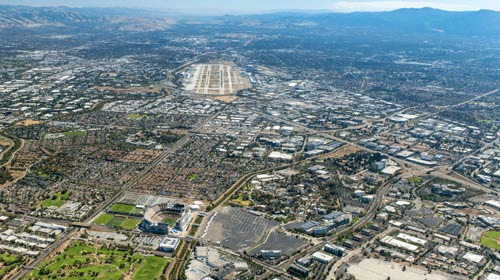
When thinking of San Jose, the first word that comes to mind is 'Silicon Valley.' It's a neighborhood filled with tech companies and high housing prices.
In fact, this area is home to global companies like Apple, NVIDIA, and Adobe, and with many engineers earning six-figure salaries, it has a strong image as a "great city to make money."
However, living here means that while many people earn a lot, the cost of living is incredibly high.
Locally, there's a joke that goes, "Even if your salary goes up, your bank balance stays the same."
San Jose's cost of living index is evaluated to be nearly double the US average.
It's not just a saying that it's one of the most expensive cities after San Francisco. Housing costs make up a large portion of living expenses.
Looking at rent, a one-bedroom apartment typically costs around $2,800 to $3,400 per month.
Two-bedroom apartments can often go up to $3,500 to $4,500. For families with children, just the rent can be a significant burden.
Even trying to buy a home, the situation is similar. The median home price in Santa Clara County exceeds $1.4 million, making homeownership a challenging endeavor.
Food costs are also considerable. It's generally about 15-20% more expensive than the national average.
Fortunately, San Jose has well-established large grocery stores like H Mart, 99 Ranch Market, and Costco, so if you shop wisely, you can reduce food expenses a bit.
It's also easy to find Korean ingredients, and for a family of four, monthly grocery costs can range from $1,100 to $1,500.
Of course, if you dine out frequently, costs can increase significantly. Transportation costs, including insurance, gas, and maintenance, can easily add up to $500 to $800 per month.
Those commuting to San Francisco may use Caltrain, but the cost of a monthly pass is an additional expense.
Utilities are somewhat better compared to other California cities. The mild climate means less need for heating or air conditioning.
Generally, combined electricity, gas, and water bills can range from $130 to $200 per month, but with PG&E's rising electricity rates, many report that their bills have become more burdensome than before.
As a result, many people do not insist on living in San Jose. While they may work in San Jose, they often find homes in nearby areas like Fremont, Milpitas, or Morgan Hill.
By doing so, they can save about $300 to $500 in rent, even if it means an additional 30-40 minutes of commute time. Over a year, that can add up to thousands of dollars in savings, making it a worthwhile consideration.
If you have a family, you also need to factor in education and childcare costs.
Dual-income couples often find themselves spending thousands of dollars a month just on daycare for their young children.
This is why even with a salary close to $200,000, people say that life is not easy.
The MIT Living Wage Calculator estimates that for two adults and two children to live comfortably in San Jose, a pre-tax annual income of about $170,000 to $200,000 is necessary.
Of course, in the IT industry, there are cases where salaries are higher than this, but after taxes, housing costs, and education expenses, the actual money left over is often less than expected.
San Jose is undoubtedly a city full of opportunities. There are many good jobs, a high level of education, and excellent living infrastructure.
However, if you are planning to move, it is important to calculate not just the salary but also the actual rent, food, transportation, and childcare costs.
It seems that the first step to succeeding in Silicon Valley is not just earning a high salary, but planning how to manage the high cost of living in advance.
 CheeryGirl
 HoldSongHae






 Rice Shop Uncle BLOG |
 Baguette Blog |
 novapixel |
 UNI Lover |
 NE Hodori Preik |
 Western US Medical Student Association |
 DOCTOR MED |

 Koreab Date |
 good thinking |
  Plastic Rose |
  Victory 1988 |
  Gook Rule |
  Rowland Mama |
  Coco and Lulu |
  washington mom |
  yorvik12 |
  HVAC will prosper |
  mortrix |
  Panorama Kstar |
  MAX009 BLOG |
  K-POP TV News |
  My Beloved Hometown Hwagae Market |
  Tart Tart |
  Min's blog |
  Tora Tora |
  pixel77 |
  cuteasducks |