
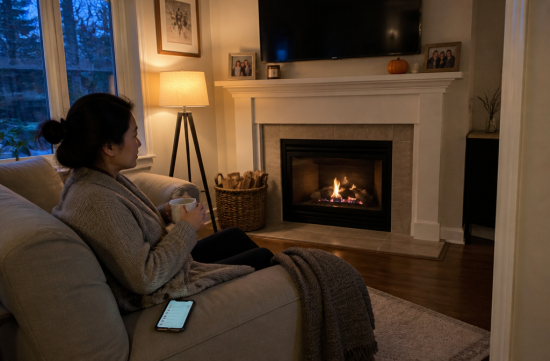
As November arrives and the evening air gets a bit chilly, I find myself lingering in front of the living room fireplace. To be honest, I've only lit this fireplace a handful of times in the past year.
Even though winter in Southern California isn't that cold, and a quick run of the heater does the trick, I still feel oddly drawn to homes without a fireplace when I go house hunting.
So today, I wanted to delve into this question: Why do Americans, including myself, hold onto fireplaces that we hardly use?
First, there's some interesting data. The National Association of Home Builders (NAHB) analyzed census data and found that in 2018, 41% of newly constructed single-family homes had a fireplace.
This number has been steadily decreasing since 2015, which surprised me as it's much lower than I expected.
What's even more interesting is the difference by price range. In the same year, only 7% of new homes under $150,000 had a fireplace, while over 60% of homes priced above $500,000 did.
NAHB explained that builders sometimes remove fireplaces to keep home prices down. In other words, a fireplace has become a symbol of a "luxurious home" rather than a necessary feature.
I believe this is key. Central heating has taken over the heating function, leaving the fireplace as a mere symbol.
In fact, the hearth was originally the center of the home. The Latin word for hearth is "focus," which is the same word we use today to mean "focal point."
Families gathered around the fire, cooking and warming themselves, and that memory is embedded in the word itself. While it's often said that the TV has taken that spot, many American living rooms still have the TV mounted above the fireplace.
Ultimately, the focal point remains the fireplace. Furniture arrangements, Christmas stockings, and family photo frames all gravitate toward that mantle.
However, there are practical constraints in Southern California. The South Coast Air Quality Management District (South Coast AQMD) runs a Check Before You Burn season from November to the end of February each year.
On days when poor air quality is forecasted, a mandatory No-Burn alert is issued. On those days, you cannot burn wood.
This means that the four months when you want to light a fire coincide exactly with the enforcement season. Isn't that a bit ironic?
New constructions face even stricter regulations. According to AQMD Rule 445, homes developed after March 9, 2009, cannot have permanent wood-burning appliances installed.
There are exceptions for high-altitude areas or places with limited gas supply, but most new developments are opting for gas fireplaces for this reason. It's best to check the official AQMD regulations for the exact conditions.
Personally, I have some thoughts on these regulations. While I understand the intent behind air quality management, it always feels uncomfortable to have such detailed restrictions on what I can burn in my own living room.
Still, the numbers make sense. There is indeed a problem with fine dust in winter, so I think a compromise of only taking a break on alert days is realistic.
Interestingly, despite these restrictions, people still want fireplaces. According to a frequently cited survey by the National Association of Realtors (NAR) from 2007, 46% of respondents said they would be willing to pay more for a home with a fireplace.
Recent industry reports indicate that the percentage of people considering it a must-have has decreased, but it still doesn't seem to easily drop off the "nice-to-have" list.
In my view, a fireplace serves as a kind of insurance. You may not use it every day, but you keep that space available for the day you want to use it.
Whether it's when family gathers for Thanksgiving, when kids hang stockings on Christmas Eve, or when you enjoy a glass of wine alone on a rainy day, those few moments can define the entire year.
In sports terms, it's like a veteran sitting on the bench. Even if their playing time is short, their presence is essential for team morale.
And there's one more thing: the power of a single photo when reselling. Agents know that a shot of a lit fireplace in listing photos can change the entire impression of a home.
That's why many people are now switching to gas logs instead of wood or even installing electric fireplaces. It's a way to create ambiance with just a switch, without worrying about smoke.
I believe this direction is the most practical. Preserving tradition while adapting methods to fit the times is what I consider pragmatism.
So the conclusion is this: even if I move to another house, I will choose one with a fireplace. Even if I only use it a few times a year.
How is your home fireplace doing these days? Whether it's become a decorative piece, switched to gas, or if you can light it on a day without a No-Burn alert this winter, I hope you get to enjoy it at least once.
 HairyPoppins
 AlstonNYer







 Art patch |

 Rice Shop Uncle BLOG |

 Noodle Noodle |

 Chino Min |

 Glow Yo |

 MEDBIO American Doctor Blog |

 humpday sonata |

 Piano Teacher Blog |

 Korean Blog |

 Information on All Regions of the United States |
 strawberry |
 US Regional Information Local News |
 USA Business News |
 Blondee |
 E whisper |
 Potato House |
 freshmint |
 Ansaso |
 Golado |
 babybay |
 honeycom |
 French Macarons |
 Exploring American Life Information |
 Sunshine Blog |
 Community Cross |
 Sayonara H |
 What can make money? |
 Information Search LifeMAN |
 morvex37 |
 neontrail |