
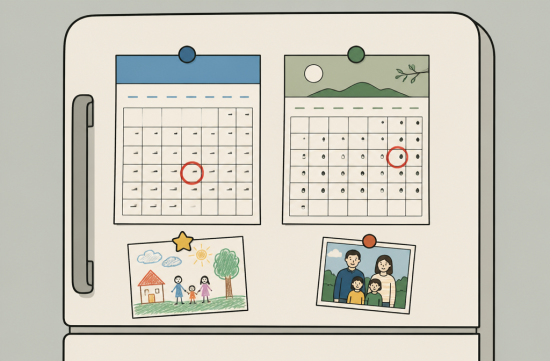
Every year around this time, I have a habit of looking at two calendars at once.
One is the American calendar stuck to my refrigerator, and the other is the lunar calendar saved on my phone.
Thanksgiving is set for the fourth Thursday in November every year, so there's no need to look it up.
However, Chuseok is different. I find myself searching for the date every year to feel reassured.
Chuseok is fixed on the 15th day of the 8th month of the lunar calendar, but when converted to the solar calendar, the date changes every year, falling somewhere between early September and early October.
So, opening the calendar app and tapping the date with my finger has become a familiar annual event for immigrants.
On the other hand, Thanksgiving has never changed since it was established by U.S. federal law in 1941 as the fourth Thursday in November.
President Roosevelt moved the date to extend the shopping season, but after backlash from several states, Congress stepped in and fixed it by law to the current date.
Knowing that background made it strangely understandable. The U.S. chose to set dates by law, while Korea opted to follow the seasons and the moon's movements.
The problem is that these two systems do not simply coexist in the daily lives of immigrants.
Thanksgiving is a day off for both companies and schools, so no one questions family gatherings on that day.
However, for Chuseok or Seollal, someone must take a day off, and children need to submit absence notes to school.
If I request a day off for Chuseok, nine out of ten people ask what that day is.
As I explain about the lunar calendar and ancestors, at some point, it becomes easier to just say it's a personal matter.
In fact, New York State only created a law recognizing Lunar New Year as a school holiday in 2023, and the first time schools actually closed was in 2025.
California is the only state that officially recognizes Lunar New Year as a holiday, while in other regions, it remains an ordinary weekday.
So, for children raised in the U.S., Thanksgiving appears to be a major holiday that the whole country celebrates, while Chuseok seems like a personal event that only their parents care about.
Children often ask why Christmas is always on December 25th, but Seollal's date changes every year.
To answer that question properly, I ultimately have to explain the difference between the lunar and solar calendars, making the task of celebrating a holiday feel like a small lecture.
In our home, Thanksgiving dinner has naturally become the biggest gathering of the year.
Even if we prepare a Chuseok feast, it often gets moved to a weekday evening or a nearby weekend for a more modest celebration.
At first, this felt a bit bittersweet. It felt like not receiving the proper treatment for a holiday.
However, over time, my perspective has changed a bit.
Thanksgiving allows us to gather for dinner without any burden, while Chuseok gives us a quiet opportunity to make songpyeon and share stories.
Having two calendars ultimately means there are two occasions to be thankful each year.
The difference is that one of those occasions is fully supported by society, while the other relies solely on our family's commitment.
So, as Chuseok approaches, I now make sure to mark it on the calendar in advance.
Since no one else will take care of that day, I've learned that I need to prioritize it for it to feel like a true holiday.
Buying two calendars may be a hassle, but it also means I have two reasons to be grateful each year, and that's how I try to think about it these days.
 Cinci
Cinci







 Giant Squid and Sweet Potato Soup |
 Lol Life |
 lavender |
 logger |
 Conflite Teacher |
 zephyrs |
  cuteasducks |
 pin pin |
 Oreore Mushroom |
 Sunset Oregon |
  pixel77 |
  Lemon Kim |
  What can make money? |
  An ant castle |
  Haha and Bomi Blog |
  glenview 89 |
  Valley Hong |
  novapixel |
  Idaho's Sumi's House |
  Mr. Midwest America |
  wildfire |
  legalway |
  postcard |
  cheesecake07 |
  My Miami Stories |
  windylotus |
  Mia Flori |
  velaro29 |
  velaro |