
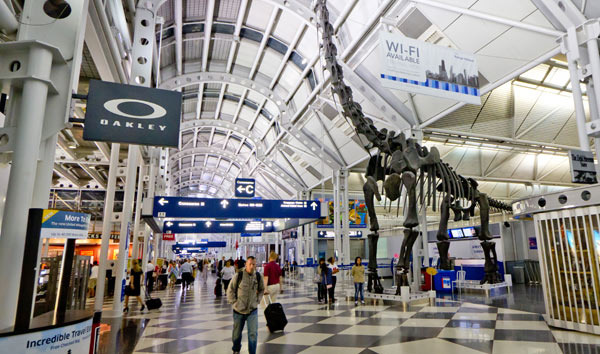
Chicago O'Hare International Airport is located in Chicago, Illinois, and is one of the busiest airports in the world, serving tens of millions of passengers annually. It officially opened in 1955 as Chicago International Airport and began to take on its current form.
Until 2005, it boasted the reputation of being the most complex airport in the world based on the number of flights. O'Hare Airport is not just a transportation hub; it is an important gateway connecting Chicago to the world and has played a unique role in aviation history.
O'Hare Airport began in 1944 at Orchard Place Airport, which was built for aircraft manufacturing during World War II. O'Hare Airport, or simply O'Hare, is named after U.S. Navy fighter ace Edward O'Hare, who received the Congressional Medal of Honor during the Pacific War.
Main Features of O'Hare Airport
1. Size and Terminal Structure
O'Hare Airport covers an area of approximately 30.9 km² and consists of four main terminals (Terminals 1, 2, 3, 5) with a total of 191 boarding gates. Terminals 1, 2, and 3 primarily handle domestic flights, while Terminal 5 is responsible for international flights, with inter-terminal transfers connected by the Airport Transit System (ATS).
2. Airline Hub
O'Hare is a major hub for United Airlines and American Airlines, connecting to over 200 destinations worldwide. It operates various international flights to Europe, Asia, South America, and the Middle East, serving as a central point in the global network.
3. Flight Records
O'Hare is regularly ranked as one of the busiest airports in the world, with over 2,700 flights taking off and landing each day. Before the COVID-19 pandemic, it served over 80 million passengers annually, playing a crucial role in U.S. transportation.
Transportation and Amenities
1. Transportation Connectivity
- Airport Transit System (ATS): An automated monorail system connecting terminals, parking lots, and the Multi-Modal Facility (MMF), operating 24 hours a day.
- CTA Blue Line: A subway that connects the airport to downtown Chicago in about 40-45 minutes, providing a convenient public transportation option.
- Road Accessibility: The airport is easily accessible via major highways I-90 and I-294, with options for taxis, rideshare services, and rental cars.
2. Parking Options
O'Hare Airport offers various parking options. The parking lots near the terminals are suitable for short-term users, while the economy parking is popular among long-term travelers. The Multi-Modal Facility (MMF) provides not only parking but also rental car services and public transport connections.
3. Airport Amenities
O'Hare Airport provides a variety of services for passenger convenience. Facilities include restaurants, cafes, duty-free shops, and souvenir stores, as well as sleeping rooms, massage centers, and lounge facilities for a comfortable airport experience. Free Wi-Fi and charging stations are available in all terminals.
Environment and Sustainability
O'Hare Airport is well-known for its efforts towards sustainability. It leads initiatives to reduce its carbon footprint through solar panel installations, electric vehicle charging stations, and eco-friendly building designs. Additionally, it contributes to environmental preservation through recycling programs that minimize waste disposal.
Challenges and Future of O'Hare Airport
1. Congestion Issues
As one of the busiest airports in the world, O'Hare has faced significant congestion issues. To address this, large-scale improvement projects are underway, including runway expansions and relocations, terminal renovations, and ATS upgrades.
2. Terminal Expansion and Modernization
The City of Chicago is investing approximately $8.5 billion to modernize O'Hare Airport. New global terminals and gate expansions will increase passenger capacity, and a smart airport system utilizing the latest technology is planned for implementation.
3. Post-Pandemic Changes
Airport operations have changed significantly following the COVID-19 pandemic. Contactless check-in and biometric technology have become widespread, with airport hygiene and safety now top priorities. O'Hare is adapting to these changes by providing innovative services.
Impact on Local Economy and Culture
O'Hare Airport has a substantial impact on the local economy, creating over 50,000 jobs and providing billions of dollars in economic value annually. Additionally, the airport offers a first impression to countless travelers visiting Chicago and plays a crucial role in shaping the city's global image.
Chicago O'Hare International Airport is not just a transportation facility; it is a key hub connecting the world and the United States, as well as an iconic location in Chicago. With its history, size, transportation convenience, and efforts towards a sustainable future, O'Hare continues to evolve and play an important role in the global aviation industry.








 Khan Film Blog Production |
 Illinois Mom |
 Rice Shop Uncle BLOG |
 Enjoyable American Life Diary |
 allstar realty |
  DREAM BIG |
  frostbite |
  330 Forever My Love |
  El Dorado |
  dralix58 |
  Gorama Round |
  Skydiving |
  dreamport |
  Yellow Snowman |
  Toaster Pizza Magic Show |
  velvetnom |
  Anytime Journey |
  Mrs. Duluth |
  jaxter |
  Atlanta Mama |
  Baguette Blog |
  Tan Sol |
  US Embassy |
  Korean Mom |
  My NYC |