

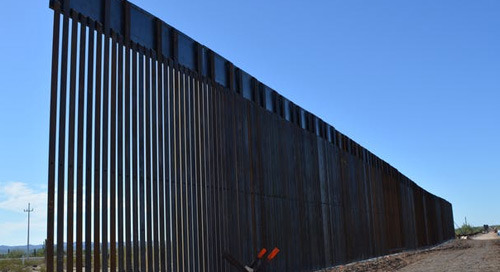
Whenever President Trump is mentioned, issues like illegal immigration, ICE, and the border come up, and this time, the construction of a wall in the Arizona Indian reservation is controversial.
It is reported that U.S. District Judge Richard Leon in Washington D.C. did not accept the request from the Tohono O'odham Nation to halt the construction of the border wall.
The Trump administration is pushing for a wall along approximately 62 miles of this tribe's reservation, and the court has deemed it legal for now.
The Tohono O'odham reservation is located in the southern Arizona Sonoran Desert and spans a massive 2.8 million acres. To put that in perspective, it's roughly equivalent to combining the entire island of Jeju six times.
This vast area is home to over 37,000 members of the Indian tribe. However, these individuals do not only reside on the U.S. side; thousands also live in Mexico.
From the tribe's perspective, a border between the U.S. and Mexico has been established right in the middle of the land their ancestors have lived on for generations.
It is said that families and relatives still live on both sides of the border.
Given this context, the idea of erecting a 62-mile wall is understandably met with resistance from the tribe.
According to the tribe's claims, it is not simply a matter of "don't build a wall on our land."
They argue that the construction of the wall could damage sacred mountains and religious sites they hold dear, and it could disrupt long-standing religious practices.
Especially when considering the massive wall that would separate families on the U.S. side from those on the Mexican side, it becomes clearer why they are sensitive about this issue.
However, the court has leaned more towards the federal government's argument this time.
Judge Leon determined that the construction of the wall does not necessarily change the boundaries of the reservation without congressional approval.
The claim that the federal government is illegally encroaching on tribal land was also not recognized at this stage.
The judge concluded that the necessity for the U.S. government to control the border, enforce immigration laws, and maintain public safety outweighs the harm claimed by the tribe at this time.
Of course, the Tohono O'odham Nation immediately responded with opposition, stating they would consider other legal actions.
Here, another interesting historical point arises.
In 1907, President Theodore Roosevelt designated a 60-foot-wide strip of land along the U.S.-Mexico border as a federal management area.
This area is commonly referred to as the Roosevelt Reservation.
Importantly, this action occurred about ten years before the current Tohono O'odham reservation was established.
Thus, legally speaking, the situation becomes quite complex. There are tribal land rights, federal border management authority, and actions taken by a president over a century ago to consider.
Living in the U.S., one might find such incidents to be very characteristic of America.
In Korea, the term "border" often brings to mind barbed wire, but the southern U.S. border passes through deserts, private lands, and Indian reservations.
Drawing a line on a map and actually building a wall in that location are completely different issues.
This time, the court did not stop the Trump administration's wall construction. However, that does not mean the tribe's claims are completely over.
Ultimately, the construction of a 62-mile wall has brought together issues of U.S. border security, over a century-old laws, and the land rights and religious concerns of Native Americans.
 RudolphBig
 GoldenHeart







 NEXT ROUND |
 Encyclopedia of New York and Surrounding Areas |
 washington mom |
 California Dreamer |
 Sugar Cream Door Bulletproof Noodles |
 Kitchen Ideas |
 Young Kim |
 Things to know |
 The Long Shot |
 orvik90 |
  San Gabriel Mountains |
  quanta7 |
  Fransco Family |
  leonee |
  Augusta 90 |
  Project Tomorrow |
  DOCTOR MED |
  Say IT Now |
  Alpha and Omega World |
  Always Dreaming of Big Success |
  Helpful Life Stories |
  Healthy Local Fresh Information |
  molten |
  Way to easy |
  intact |
  happy 9 |
  Park M.Y. |
  tredon |