
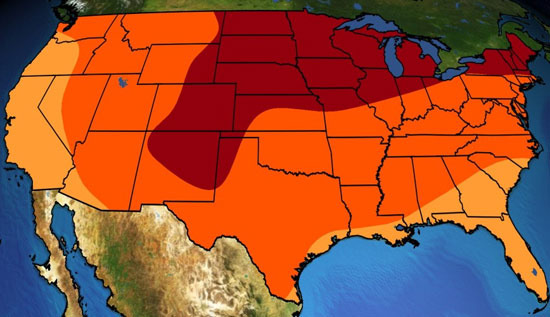
The weather in Ohio is so changeable that it is often described as unpredictable.
It can be warm enough to take a walk in a t-shirt one day, and then suddenly snow the next day haha.
Especially in central areas like Columbus, it can get extremely cold in winter or unusually hot in summer, not just because the climate is extreme, but due to geographical features.
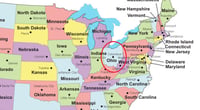
Ohio is located roughly in the middle of the eastern and midwestern United States. To the north is Lake Erie, to the south is Kentucky, to the west is Indiana, and to the east is Pennsylvania. This location has a huge impact on the weather. In particular, the cold in winter is largely due to the 'Arctic air mass' from the north moving south.
The cold air blowing from Canada picks up moisture as it passes over the Great Lakes, and by the time it reaches Ohio, it is already cold and humid. Therefore, the northern areas, especially near Cleveland, can experience heavy snowfall in a short time due to the 'Lake Effect Snow.' Columbus is inland, so it doesn't get as severe, but it still often experiences rapid drops in temperature due to this cold air flow.
So even in the same winter, there can be extreme changes from 5 degrees Celsius to minus 15 degrees Celsius within a few days. Additionally, the winter winds are a problem. Ohio has many flat areas, so there are few mountains or forests to block the wind. As a result, when the northwest wind blows, the wind chill makes the temperature feel much lower than the actual temperature. On days with strong winds, it can feel like minus 20 degrees even when it is minus 10 degrees.
On such days, your face can feel numb, and frost can form on your eyebrows. Therefore, Ohio residents often use the term "Wind chill" in winter. It's not just cold; there is a unique chill that feels more like a 'cutting wind' due to the wind. Conversely, the reason summer is so hot is clear. Ohio has a continental climate, so there is no buffering effect from the ocean. This means that temperatures do not change gently like in a maritime climate, and it absorbs solar heat directly.
Especially in July and August, hot air from the Gulf of Mexico moves north, increasing humidity. So even when the temperature is around 33-35 degrees Celsius, it can feel close to 40 degrees. On such days, the air is sticky and suffocating. In summer evenings, showers often occur, which is a typical 'convective rain' caused by rising hot air. Suddenly, the sky darkens around sunset, and lightning flashes as a downpour occurs.
Fortunately, these rains do not last long and stop quickly, but after they pass, the humidity rises again, making the air feel heavy. Another variable in Ohio's weather is the 'Jet Stream.' This is a strong wind flow that moves quickly in the upper atmosphere, changing the weather dramatically as it moves north and south with the seasons. When the jet stream stays to the north, warm air comes in, leading to mild weather, and when it moves south, cold air from the Arctic flows down to Ohio.
As a result, even in the middle of winter, it can suddenly warm up for a few days, only to have a cold snap the following week. Ohioans express this unpredictability with the joke, "If you don't like the weather, wait five minutes." Ultimately, Ohio's climate is the result of a combination of four factors: 'continental climate,' 'flat terrain,' 'proximity to the Great Lakes,' and 'influence of the jet stream.' Therefore, experiencing extremely cold or hot days is somewhat of a fate for this region.
However, thanks to this unpredictability, Ohio's seasons are quite distinct. In spring, cherry blossoms bloom, in summer, the greenery is lush, in autumn, the foliage colors the city, and in winter, the snow-covered landscape looks picturesque.






 Ohio Ohayoung Hello |
 fixed |
 MACCITON Real Estate |
 yentra |
  Make My Day |
  Victory 1988 |
  Tonky |
  viroma |
  cookie |
  Live and that's it |
  Alright Twain |
  eatontown blog |
  HAWAII Korean Church News |
  Amore |
  linex |
  Balancework |
  laro90 |
  MEDBIO American Doctor Blog |
  SWAT TEAM BLK |
  DREAM BIG |
  frostbite |
  330 Forever My Love |
  El Dorado |