
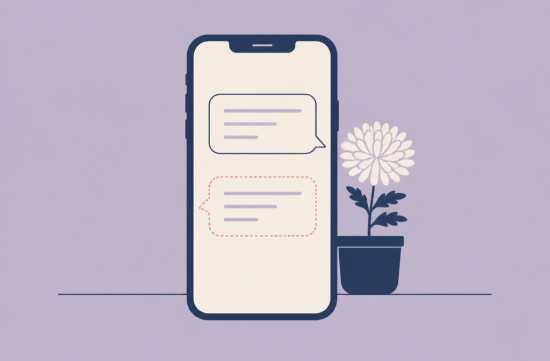
Recently, I've been seeing an ad pop up in my feed. It's for a service that claims to bring back the voices and mannerisms of deceased family members using AI, allowing for conversations with them again.
At first, I brushed it off, but one night I found myself staring at that ad for quite a while. If I could talk to my mom just one more time, would I click on this?
In English-speaking countries, this is referred to as a griefbot or deadbot. It's a chatbot that learns from data like texts, emails, voices, and videos of the deceased to respond like that person.
In fact, the idea was first strongly impressed upon us by a Korean broadcast. Many of you might remember the VR documentary "I Met You" aired by MBC in February 2020.
It featured a scene where a mother, Ji-sung Jang, who lost her seven-year-old daughter, Na-yeon, puts on a VR headset and meets her virtual daughter again. The production team reportedly spent eight months creating Na-yeon's face, body, and voice.
Back then, it was VR, and there was a script. Now, the story is different; generative AI can create responses on the spot.
A notable example of this change in the U.S. is "The Jessica Simulation," published in the San Francisco Chronicle in July 2021. It tells the story of a man named Joshua Barbeau who used old messages from his fiancée Jessica, who passed away in 2012, to have conversations on a site called Project December.
The site was based on GPT-3, and he paid $5 for it. Honestly, I was a bit stunned by that number—just $5 to hear the voice of someone you miss again.
Since then, the market has grown quite a bit. There are services like HereAfter AI, which started in 2019, that allow you to record interviews while you're alive so that later, your family can ask questions and hear your voice in response.
Hearing all this, you might think, "Isn't it good if it provides comfort?" There are indeed research findings that support this.
A study published in the proceedings of the Designing Interactive Systems conference in June 2026 reported that some bereaved individuals find solace in conversations with such AIs. The researchers referred to this as generative ghost.
However, there are significant opposing voices as well. A representative paper published in Philosophy and Technology in May 2024 by Tomasz Hollanek and Katarzyna Nowaczyk-Basinska from the Leverhulme Centre for the Future of Intelligence at Cambridge University describes this field as "high risk." They warn that unwanted digital haunting could occur, where the chatbot of the deceased continues to reach out.
There was an even more chilling scenario mentioned. A chatbot mimicking a mother's voice could potentially be used in advertising by recommending specific brand foods.
As a result, the paper proposed several measures: explicit consent for using the deceased's data, an opt-out option for users to end the relationship, and a procedure for "retiring" the chatbot.
An example of this procedure is a digital funeral. At first, it seemed a bit funny, but the more I thought about it, the more it made sense; a relationship without closure isn't really a breakup.
A similar conclusion was reached in a paper published in JMIR in 2026. Griefbots are meaningful when they assist in existing mourning practices like counseling, but they shouldn't replace them.
Where does the law stand on this? California signed AB 1836 in September 2024, which went into effect on January 1, 2025.
This law holds individuals accountable if they use a deceased person's digital replica in videos or audio without consent. However, it primarily applies to individuals who had commercial value at the time of their death, such as actors or musicians.
This means that a personal chatbot created from the texts of an ordinary mom isn't directly covered by this law. Ultimately, consent and data management still heavily rely on company terms and family judgment.
Here, I have a question that I've been pondering for a long time. Would my mom have wanted this?
What if opinions differ among siblings? Some might want to talk every day, while others could be devastated just hearing that voice.
From a Korean perspective, this isn't entirely unfamiliar. We have a culture of speaking to the deceased at ancestral rites and sharing updates at their graves.
However, there's a crucial difference. The ancestral altar doesn't respond.
Because there's no response, we gradually accept that the person has truly left. AI responds, but those responses are not actual words spoken by mom; they are probabilities of what she might have said.
So, I would prefer to take a middle ground. I would cherish the actual recordings or videos left by my mom but would likely avoid using a chatbot that generates new words.
If someone decides to use one, I would recommend setting a time limit and combining it with counseling. It might also be a good idea to ask your living parents if they would want something like this.
In the end, I didn't click on that ad today. Instead, I listened to an old voicemail on my phone.
What would you do? It's a question without a right answer, and I'm really curious about what others think.
 FlixFlex
 roadwalker








 Art patch |

 Rice Shop Uncle BLOG |
 Noodle Noodle |

 Chino Min |

 Glow Yo |

 Various Knowledge and Information in the USA |

 Cali M Law Group |



 There Are Such Things in the World |
 action blog 101 |
 athome blog |
 calvor |
 Haha and Bomi Blog |
 Lee Ton |
 viba viba |
 Olivia's Blog |
 208 Master |
 crumb |
 blanke |
 Burbank Lee |
 tervox95 |
 silverado |
 Grow Your Gut Bacteria Well |
 Kim You Shin |
 Squid Q |
 gelatonew |
 river9 |
 ttano |
 Eagle in America for Five Years |