
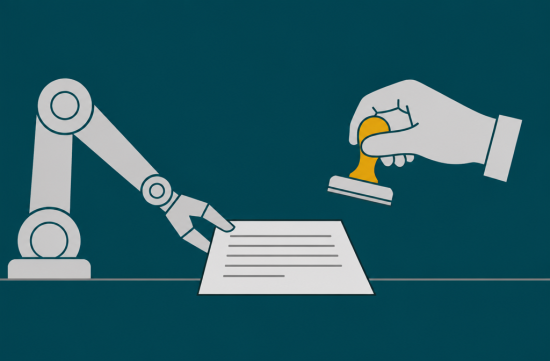
Do you know what the scariest scenario is among Silicon Valley workers these days? You log in in the morning only to find your account locked, with just a single line stating "system judgment" as the reason.
It may sound like a joke, but in a place where performance dashboards, productivity scores, and automated attendance checks are already part of daily life, it's a pretty realistic concern. However, California has drawn a line on this issue.
Governor Newsom signed SB 947 on September 30, 2026. Its nickname is the No Robo Bosses Act, which literally means "robot boss ban law."
The core idea is simple. Employers cannot rely solely on automated decision-making systems, or ADS, for disciplinary or termination decisions.
The scope of ADS is broader than you might think. It includes not just tools labeled as AI but also machine learning, statistical models, and any computational processes that assist in making decisions.
So, does this mean companies can't use AI at all? Not quite. AI can make recommendations, but the final trigger must be pulled by a human.
Specifically, if the results from ADS were primarily used as the basis for discipline or termination, a person must directly verify those results against original data or other sources.
Verification materials may include performance evaluations, personnel files, peer reviews, and witness interviews. This means you can't just look at a screen and hit "OK" as a rubber stamp.
If a person reviews the results and finds that the AI's conclusions are inaccurate or incomplete, then those results cannot be used for discipline or termination.
From the employee's perspective, the most noticeable change will be in the notification process. When informing an employee of a decision, a separate written notice must be provided.
This notice must include the fact that ADS was primarily used. It should also state that a person reviewed and verified the information, along with the contact person for inquiries.
It also specifies the right to request an explanation of how one's data was used, and that retaliation for exercising this right is prohibited. Personally, I found this aspect to be the most welcome.
The law will take effect on July 1, 2027. It won't change overnight, so consider this a preparation period for companies.
Violations will incur a civil penalty of $500 per incident, enforceable by the Labor Commissioner and the Attorney General. However, there is still some debate about whether "one incident" is counted per employee or per decision.
In fact, this law is a second attempt. SB 7, introduced in 2025, passed through the legislature but was vetoed by Newsom.
The reason for the veto at that time was that it overly restricted employers' use of tools. Therefore, this version narrowed the scope to focus on discipline and termination, ultimately securing the signature.
There was also another law signed on the same day. SB 951 requires notification in cases of mass layoffs or relocations due to AI, while AB 1331 and AB 1883 limit the use of workplace surveillance tools.
Let's also clarify the applicability. According to legal analysis, the law applies to both public and private employers regardless of the number of employees, with exceptions only for unionized workers meeting certain criteria. This means small startups are not exempt.
So what does this mean for Silicon Valley? I see three major implications.
First, companies will need to conduct audits of their HR tools. They must create a list of which systems are used for performance or attendance assessments and document the human review processes.
Second, managers will definitely have more work. They can't just pass along a list of low performers generated by AI; they need to verify the basis for those results and take responsibility.
Third, this could effectively set a national standard. For tech companies with employees in California, it may be easier to apply the same processes to employees in other states for management purposes.
Of course, there are opposing voices. The industry has raised concerns about regulatory burdens and costs since the SB 7 days, and there are ongoing criticisms about the ambiguity of the definition of "violation."
I don't think those criticisms are entirely unfounded. However, since termination affects a person's livelihood, I believe it's not unreasonable to require that a human verify the basis for such decisions.
Employees can also take steps now. It's a good first step to be aware of what performance measurement tools the company uses.
If you later receive a disciplinary notice, check whether it came with an ADS-related notification. If it did, it's wise to request a written explanation of how your data was used.
Keeping a habit of organizing performance-related emails or 1:1 records can also be helpful. You need to have materials to counter when a human reviews the case.
If the situation is complex, consulting with the labor department or an employment attorney is the most reliable option. The interpretation of legal provisions can vary by case.
Ultimately, the message is clear. AI is just a tool, and the responsibility for making termination decisions lies with humans. I would suggest asking how our company's HR is preparing before July 2027.
 foxriverbuilder1975








 neroyo |

 American Food Information & Calories |
 Bald Eagle Brothers |

 sunny side |

 kodak |

 Moscow Kim |

 Breaking Bad Drama |

 DOCTOR MED |

 U.S. Weather Bureau News |

 Shining Our Own World |
 action blog 101 |
 athome blog |
 calvor |
 Haha and Bomi Blog |
 Lee Ton |
 viba viba |
 Olivia's Blog |
 208 Master |
 crumb |
 blanke |
 Burbank Lee |
 tervox95 |
 silverado |
 Grow Your Gut Bacteria Well |
 Kim You Shin |
 Squid Q |
 gelatonew |
 river9 |
 ttano |
 Eagle in America for Five Years |