
Last week, while waiting for coffee at my favorite café, I overheard a conversation between two seniors at the next table. They were discussing how home prices have risen, but their pensions remain the same, leading to sighs every time they see their property tax bills.
Then one of them asked, "Have you applied for the tax freeze?" The other looked surprised, as if he had never heard of it. At that moment, I perked up and went home to look it up.
To get straight to the point, Davidson County has a Property Tax Freeze program that locks in the property tax amount for homeowners aged 65 and older. The office responsible for this is the Office of the Metropolitan Trustee.
The key aspect is that it fixes the amount you pay, not the tax rate itself. According to the Tennessee Comptroller's explanation, the tax amount from the year you first qualify becomes the baseline.
Even if the tax rate increases or there is a county-wide reassessment, that amount remains unchanged. In a rapidly rising housing market like Nashville, this is quite a reassuring measure.
So, who can apply? First, you must be 65 years old by December 31 of the tax year you are applying for.
Additionally, the home must be in your name and be your primary residence. Second homes or rental properties do not qualify.
The most important factor is the income limit. For the 2026 tax year, the income limit for the Davidson County tax freeze is $63,470.
This amount is based on 2025 income and includes the combined income of the applicant, spouse, and all homeowners. Last year's limit was $61,920, so it has increased by $1,550.
It's also good to know how income is calculated. The Trustee's office guides applicants to take the federal tax return form 1040, subtract line 6b (taxable social security) from line 11 (AGI), and add line 6a (total social security amount).
This means that all social security income, including non-taxable portions, is counted as income. The numbers can add up more than you might expect, so it's wise to calculate in advance.
Pension, IRA withdrawals, rental income, and profits from the sale of stocks or real estate are all included. If you haven't filed taxes, you can submit your 2025 income documents along with a bank statement showing one month of social security deposits.
There is also a separate program called Property Tax Relief with a lower income limit. For 2026, the limit is $38,470, and if you qualify, it's good to look into both programs.
The application timeline is as follows. New applications start in the fall, and the deadline for the 2026 tax year is April 5, 2027.
One condition that is easy to overlook is that according to the Trustee's checklist, not only must the application be submitted by the deadline, but the property taxes for that year must also be fully paid.
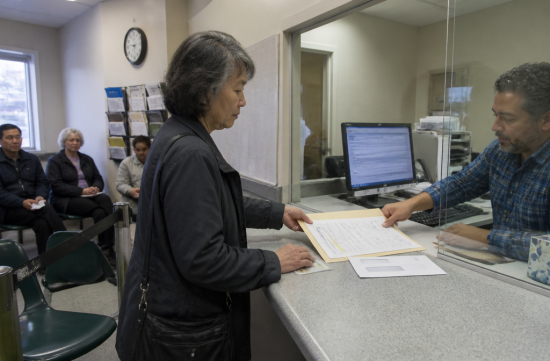
First-time applicants must visit in person. The location is the Howard Office Building at 700 President Ronald Reagan Way, Suite 220.
Hours of operation are weekdays from 8 AM to 4:30 PM, and they are closed on weekends. While you can go without an appointment, they advise arriving before 3 PM with your documents.
The documents you need to bring include your driver's license and Medicare card, as well as a complete copy of your 2025 federal tax return. If your driver's license address differs from your home address, you will also need additional proof of residency, such as 2026 auto insurance documents or a voter registration card.
If your spouse or co-owner has passed away, you will need to provide a death certificate, and if you are divorced, you will need to submit the divorce decree. If the home is in a revocable trust, you must provide the relevant documents, and irrevocable trusts do not qualify.
If you are already enrolled, the process is a bit easier. You will receive a re-certification voucher by mail in the fall, which you can sign and return before April 5, confirming that your income is below the limit.
However, remember that you must re-certify every year. If you miss a year, you could lose your benefits, so it's recommended to mark it clearly on your calendar.
There are a few exceptions as well. If you expand or remodel your home, the fixed amount will increase proportionally to the added value.
If you sell your home and move, the freeze does not carry over. You will need to qualify again in your new home, and the tax for that year will become the new baseline.
On the flip side, there is a favorable regulation. If the calculated tax is lower than the fixed amount, you can pay the lower amount, and that will become the new baseline going forward.
Honestly, I find it a bit disappointing that this program is not more widely known. It is especially necessary for those who have lived in neighborhoods like East Nashville or Germantown, where the community atmosphere has changed dramatically over time.
I have heard that many Korean seniors delay applying due to language barriers with English documents. Helping them out could make a significant difference.
For ambiguous issues like income calculations or trust matters, it's essential to check with a tax professional or the Trustee's office (615-862-6330). Official guidance is available on the nashville.gov Trustee page.
If it were me, I would gather my documents this month and make a trip before getting swept up in the holiday season. The lines are bound to be long right before the April deadline.
 SickKnight
 TopSummit


 American Politician Community |

 memorabilia |
 orvian89 |

 looksee 78 |

 vivavida |
 swiftlane |

 Goroke Geureoke News |

 U.S. Weather Bureau News |


 yorvik12 |
 lollipop |
 lioness |
 DREAM BIG |
 corner |
 Shintongbangtong Shin Naerin James Park |
 primeleaf |
 forward |
 action blog 101 |
 athome blog |
 calvor |
 Haha and Bomi Blog |
 Lee Ton |
 viba viba |
 Olivia's Blog |
 208 Master |
 crumb |
 blanke |
 Burbank Lee |
 tervox95 |