
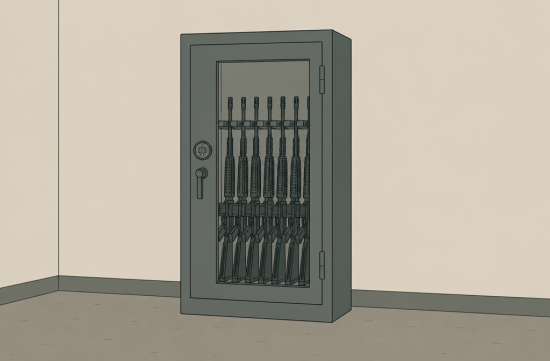
Recently, I visited an indoor shooting range and found myself stopping in front of a display case. Among the latest models, there was a familiar silhouette of a rifle that many have seen in movies or news broadcasts.
This rifle, with its angular stock and slightly curved magazine, is part of the AK-47 family. Designed by Mikhail Kalashnikov in the Soviet Union in 1947, it is considered the most produced and sold gun in the world.
Experts in small arms estimate that at least 76 million AK rifles have been produced to date. Few firearms in history have reached such production numbers.
Its reputation stems from being inexpensive, reliable, and able to fire even when muddy, as long as the trigger is pulled. During the Cold War, the Soviet Union spread production licenses to allied countries, allowing this gun to proliferate across continents.
As a result, whether watching news from conflict zones or old war movies, this gun is always present. The title of the most common weapon in the world is not just a coincidence.
However, when we shift to the situation in the United States, the picture changes. In a country known for its high number of guns, the percentage of people who own guns is gradually decreasing.
According to research from Harvard and Northeastern University, the total number of guns in the U.S. increased from 192 million in 1994 to 265 million in 2015. During the same period, the percentage of adults who reported owning a gun fell from 25% to 22%.
This means that while the number of guns continues to rise, the number of people holding them is actually declining. At first glance, this might seem contradictory.
The answer is simple: a small number of people are buying and stockpiling guns in much larger quantities than before.
The same study revealed that 3% of American adults, referred to as super owners, own about half of all guns in the country. On average, each of these individuals owns 17 guns.
For reference, the most sold rifle in the U.S. is not the AK-47 but the AR-15 family. Industry data indicates that over 28 million of these rifles are in circulation in the U.S., meaning that different guns hold the records for global and national sales.
What surprised me here is that in discussions about gun control, people often focus on how many individuals own guns, but rarely consider how many guns a single person possesses. The real picture is much closer to the latter.
When discussing gun regulation, the common statements about there being too many guns and too many gun owners are entirely different issues. Mixing these two arguments diminishes the persuasiveness of either side.
Personally, I've noticed an increase in people who have never touched a gun, while on the other hand, there are more individuals filling their homes with multiple gun cabinets. It's becoming rare to hear of someone who only owns one or two guns at the shooting range.
Shooting is ultimately a hobby, and I find it oddly relatable when I hear that once someone gets into it, they tend to accumulate guns just like golf clubs. It seems strange that while other hobbies are viewed this way, firearms are treated differently.
While the most sold gun in the world remains a symbol of war, in the U.S., the profile of gun buyers is increasingly narrowing to a smaller, more serious group of enthusiasts. The changing demographics of gun owners is a more intriguing question than the guns themselves.
 Cream gelato




 Giant Squid and Sweet Potato Soup |
 Lol Life |
 lavender |
 logger |
 Conflite Teacher |
  yorvik12 |
 zentra95 |
 axelon47 |


 Vivid U.S. Regional Information |
  mortrix |
  My Beloved Hometown Hwagae Market |
  Tart Tart |
  Min's blog |
  Tora Tora |
  pixel77 |
  cuteasducks |
  Lemon Kim |
  What can make money? |
  An ant castle |
  Haha and Bomi Blog |
  glenview 89 |
  Valley Hong |
  novapixel |
  Idaho's Sumi's House |
  Mr. Midwest America |
  wildfire |
  legalway |
  postcard |