
Do you know what word comes up most often in my friends' group chat lately? Surprisingly, it's "Toyota."
A friend who is about to graduate shared a screenshot of a job posting from the Georgetown plant, and when everyone saw the hourly wage, there was a moment of silence. So, I got curious and did some research.
First of all, the scale is impressive. The Toyota Motor Manufacturing Kentucky (TMMK) plant in Georgetown is the largest vehicle manufacturing facility that Toyota has worldwide.
It reportedly employs around 10,000 people. It's a quick drive north on I-75 from Lexington, making the commute quite reasonable.
This March 23 marked the 40th anniversary of the plant. At that time, Toyota announced an additional investment of $800 million in Kentucky.
This money is said to be used for preparing to produce a second electric vehicle and expanding the assembly capabilities for the Camry and RAV4. They have also announced plans to produce a three-row electric SUV here.
Earlier, in November 2025, there was a plan for an investment of $204 million for hybrid production and the creation of 82 new jobs. The hybrid engine line is expected to be ready by 2027.
A new paint shop also broke ground this June. It is a $922 million project and is scheduled to be operational by 2027. As the plant expands, more people will be needed to operate and maintain the equipment.
So, what positions can people like us, the Korean community, aim for? In my view, there are three main paths.
The first is in production, officially titled Production Team Member. This is an entry-level position that even those new to factory work can consider.
According to the Toyota careers page, this position starts at $23.50 per hour and can go up to $36.55 over four years. It requires a standard 40-hour workweek with mandatory overtime.
However, a recent announcement from the Kentucky Manufacturing Association indicated that wages range from $21 to $24.50 depending on experience, with an additional $1 per hour for night shifts. The numbers can vary slightly from posting to posting, so be sure to check the specific job listing.
Based on the highest hourly wage after four years, even just calculating for a 40-hour workweek, that exceeds $70,000 annually. Considering the overtime, it's a pretty solid starting point for a first job.
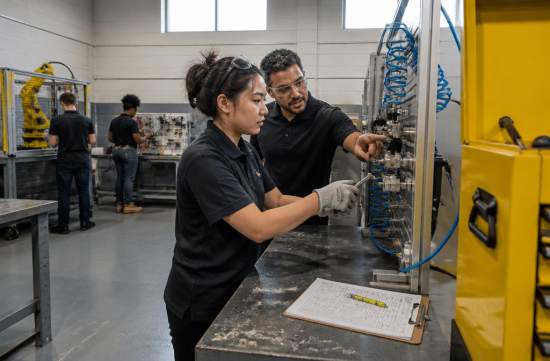
The second option is skilled maintenance, which involves equipment repair. The hourly wage jumps significantly here.
The careers page lists a starting wage of $38.93, rising to $44.70 after three years. I was genuinely surprised when I saw that.
However, many positions require practical experience or qualifications in areas like electrical, mechanical, or hydraulic systems. It's not just a position anyone can walk into.
This makes the third path interesting. It's the Advanced Manufacturing Technician (AMT) program run jointly by Bluegrass Community and Technical College (BCTC) and Toyota.
This is a two-year associate degree program where students attend classes two days a week and work 24 hours at a partner company while getting paid. For friends worried about tuition, this is a great opportunity.
This model started in Kentucky in 2010 under the name FAME and has since spread to other states. It's nice to know the original program is right in our backyard.
There are eligibility requirements as well. Minimum standards for math course grades and ACT scores exist, and applicants after February 1 are not guaranteed an interview, according to the school's website.
According to the school's page, graduates can earn an associate degree in industrial maintenance technology along with two years of practical experience and an AMT certificate all at once. That's not just one line on a resume, but three!
If you have friends in engineering, there are also engineering or administrative positions that are consistently posted, so it's a good idea to check the job sites regularly.
I'll share a few practical tips as well. First, checking the official Toyota careers site is the most accurate way to find job postings.
There may be times when the careers page indicates that they are not accepting applications. Setting up alerts and waiting is the best approach.
Be prepared for shift work and mandatory overtime as well. Those with many weekend commitments should seriously consider this aspect.
Some friends have asked if they need to know Japanese to work at a Japanese company, but from what I've seen in the production and maintenance job descriptions, there are no specific language requirements. So, it seems more important to focus on physical stamina and reliability.
Eligibility to apply may vary depending on your residency status or visa, so be sure to check the specific job requirements.
Honestly, when I think of factory work, I used to have an old-fashioned image in my mind. But seeing the influx of electric vehicles, hybrids, and new paint shops has changed my perspective.
If it were me, I would probably look into the AMT program first rather than jumping straight into production. Earning a degree while working and transitioning into a maintenance career track seems like the most solid plan.
For friends who are feeling clouded by job worries, take a moment to look up at the sky in Georgetown. There might be a clearer path than you think.
 AcornHeight
 ShrimpPower




 Exploring American Life Information |

 Franco Family |

 Home Run King Byeon Seung-yeop Blog |

 mistic |

 Hodong Prince Over Flex |

 The 2000 |

 Cahty Chung |

 skyblue |

 Lee Ton |

 Kentucky Fried Chicken |

 Shining Our Own World |
 Raymond K. |
 gravity |
 714 Success Era Real Estate |
 Investment Beginner Company Information Encyclopedia |
 musicque |
 The Gelaton |
 ovelion |
 Chicagonian |
 Freedom Yea |
 AZ Road Master |
 glenix39 |
 Something is popping in the situation |
 orvella |
 vella |
 comets |
 Banana |
 Yes Dorian |
 Minnesota Sonata N |
 zentar |