
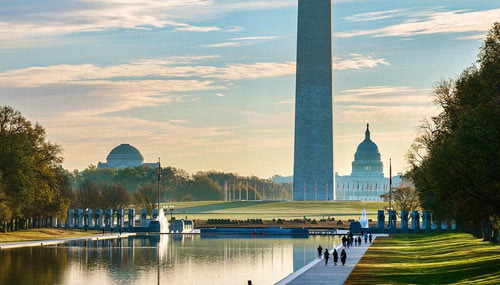
In a nutshell, the weather in Washington DC can be summed up as "faithful to all seasons."
Spring is beautiful, summer is hot and humid, fall is breathtaking, and winter can be harsh at times. It's not as mild as California year-round, nor as extreme as Minnesota; it's somewhere in between that defines DC weather. Here's a breakdown of the data.
Spring (March to May) is the most beautiful season in DC. The cherry blossoms that bloom from late March to early April paint the Tidal Basin pink, attracting tourists from around the world. Temperatures are pleasant, ranging from 15 to 22 degrees Celsius (60 to 72 degrees Fahrenheit) during the day. However, spring rains are frequent, and temperature fluctuations can be significant, requiring a heavy jacket one day and short sleeves the next. It's also the toughest season for those with pollen allergies, as the pollen count from trees and grasses peaks during this time.
Summer (June to August) is the harshest season in DC. The average high temperature in July is between 31 to 33 degrees Celsius (88 to 91 degrees Fahrenheit), and the unique high humidity near the Potomac River can make it feel like it's over 40 degrees Celsius (104 degrees Fahrenheit) on some days. There's a story that British diplomats classified DC as a tropical climate when the U.S. federal government first designated it as the capital, demanding tropical allowances. Air conditioning is essential, and outdoor activities are best done early in the morning or in the evening. The annual rainfall is about 39.7 inches (1,008 mm), relatively evenly distributed, but sudden summer downpours are common. Some data suggests that in terms of precipitation, DC is similar to or even exceeds tropical cities like Mumbai.
Fall (September to November) is the second most beautiful season in DC. The average temperature in October is a comfortable 15 to 20 degrees Celsius (59 to 68 degrees Fahrenheit), and the fall foliage peaks in mid to late October, creating a stunning display of reds and golds in DC and the nearby Shenandoah Valley. The Marine Corps Marathon in October is also one of the signature events of the season. Fall allergies (ragweed) peak in September but are generally less severe than in spring. Winter (December to February) can see temperatures drop below freezing, with the average low in January around -3 degrees Celsius (27 degrees Fahrenheit). Snow falls about 38 cm (15 inches) on average per year, but there can be significant variation. Some winters see very little snow, while others, like the Snowmageddon in 2010, can accumulate over 75 cm in just a few days.
As a tip for dealing with the weather in DC, both winter coats and summer cooling gear are essential. Winter boots and waterproof jackets are must-haves for winter living in DC. In summer, it can be tough without deodorant and cooling fans or air conditioning. The UV index is also high in summer, so sunscreen is a necessity. The four seasons in DC definitely have their own personalities, so those coming from Korea will likely find the seasonal changes familiar. However, it does take some time to adjust to the humid summer heat.
 PotatoChip
 SweetRiver







 US Regional Information Local News |
 nero kim |
 OC Real Estate Business Information |
 Nevada Vegas UNLV |
 My Love DS |
 Holey Moley |
 El Dorado |


 Leapfrog Move |
  Finding Superfoods |
  COLO COLO |
  morixa |
  USA Hyundai Kia |
  My Town My Way Blog |
  Splendid Mission |
  Yonori Nori |
  Unknown Dog Walk blog |
  Dingho and USA News |
  Enjoyable American Life Diary |
  Sammy Beach |
  Nanana Nanana Nanana |
  UNI Lover |
  Sunny's Travel in America |