
Last month, during a church small group meeting, a deacon shared a prayer request. His mother had fallen and spent three days in the hospital, but when it came time to transfer her to a rehabilitation facility, he heard that Medicare wouldn't cover it.
She was clearly lying in a hospital bed, undergoing tests, and eating meals provided by the hospital. However, on paper, she was classified as an observational patient rather than an inpatient.
After the meeting that day, I went home and researched for quite a while. It didn't feel like someone else's issue. It's something that affects our parents' generation, and soon it will be our turn, so I wanted to clarify it.
First, we need to clarify what an observational patient (observation status) is. It's a status where the hospital is monitoring whether to admit the patient, and Medicare classifies this as outpatient care.
Even if they are in the same room and bed, inpatient care is processed under Part A, while observational care is processed under Part B. From the patient's perspective, there may not seem to be any visible difference, making it easy to overlook.
The issue arises with nursing facilities, specifically skilled nursing facilities (SNF) coverage. Original Medicare Part A requires a formal admission of at least three days before covering SNF costs.
However, the day sent as an observational patient does not count toward these three days. The same goes for time spent in the emergency room.
You should also be aware of how the counting of days works. Admissions are counted based on the date at midnight, and the day of discharge is excluded from the calculation.
So, even if you spent four days in the hospital, if only two days are counted as an admission, you won't meet the requirements. That was exactly the case for the deacon's mother.
If the conditions are met, the benefits can be quite significant. As of 2026, the first 20 days in an SNF are covered with no out-of-pocket costs, and from the 21st to the 100th day, the cost is $217 per day.
Last year, it was $209.50 per day, so it has increased slightly this year. If the conditions are not met, this benefit disappears, and the family has to bear the full cost of the facility.
The hospital bills incurred while in observational status are also billed under Part B. The Part B deductible for 2026 is $283, and after that, a typical 20% coinsurance applies.
For reference, the Part A deductible for inpatients in 2026 is $1,736. You can't definitively say that observational patients are always more expensive; ultimately, it comes down to whether rehabilitation is needed after discharge.
So how can you tell if you are an observational patient? If the observational status exceeds 24 hours, the hospital must provide a written notice called MOON.
The official name is Medicare Outpatient Observation Notice, and it must be given within 36 hours after observation begins, or at discharge if you leave before that.
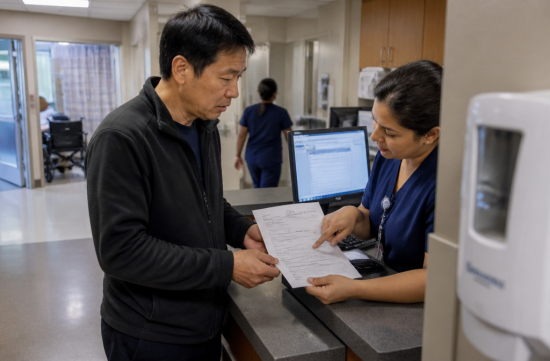
If you received this paper, it means you are classified as an observational patient. It's easy to just sign it and move on in the chaos, but you shouldn't do that.
If you don't remember receiving it, the best way to confirm is to ask directly. Make sure to check with the nursing station or case manager, asking, "Am I currently an inpatient or in observation status?"
There's also some good news. In the past, if a patient was switched from inpatient to observational status, there weren't many avenues for recourse, but now there is an appeals process.
As a result of the class action lawsuit Alexander v. Azar, which began in 2011, CMS issued final regulations in October 2024. Hospitals have been applying this process since February 14, 2025.
Patients who qualify and have their status changed from inpatient to observational during their stay will receive a notice called the Medicare Change of Status Notice. Receiving this allows for a quick appeal to an external review organization (QIO).
The eligibility criteria can be quite strict. It includes cases where there is no Part B, or where the patient was in the hospital for more than three consecutive days but was not processed as an inpatient for three days.
There was also a retroactive appeal process for past cases. However, the original deadline for submissions was January 2, 2026, and now it requires a valid reason for being late.
If you are a Medicare Advantage subscriber, the situation may be different. Depending on the plan, some may waive the three-day admission requirement, so it's best to ask your specific plan directly.
What I realized while studying this is that much of this trap can be avoided with the right information. It's most frustrating to suffer from ignorance.
If it were me, I would ask about the status immediately when my parents are hospitalized. And if it seems likely that rehabilitation will be needed after discharge, I would politely request the attending physician to reconsider the admission decision.
Of course, insurance conditions vary based on enrollment type and medical history. Since it differs by individual circumstances, I recommend checking with a SHIP counselor or Medicare expert.
The deacon's family is currently exploring various options due to the facility cost issue. Our group continues to keep them in our thoughts.
It's not easy to manage even a single piece of paperwork while being by the side of a sick family member. Still, I hope you remember that just asking, "Am I currently an inpatient?" can save thousands of dollars.
 TamiaBooks
 OceanWave




 Conflite Teacher |

 Tainami American Travel Story |

 tarve7 |

 puddingcat |

 American Politician Community |

 dravion |

 keltrio |

 Ansaso |


 veltrix |
 Raymond K. |
 gravity |
 714 Success Era Real Estate |
 Investment Beginner Company Information Encyclopedia |
 musicque |
 The Gelaton |
 ovelion |
 Chicagonian |
 Freedom Yea |
 AZ Road Master |
 glenix39 |
 Something is popping in the situation |
 orvella |
 vella |
 comets |
 Banana |
 Yes Dorian |
 zentar |
 mykiwi blog |