

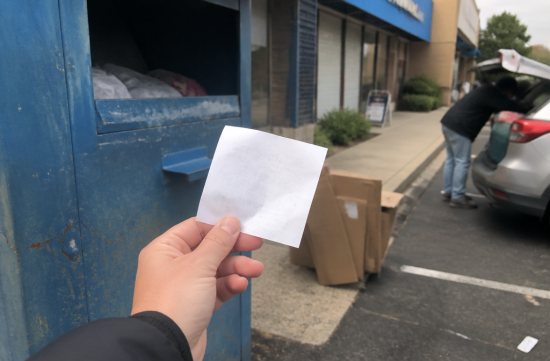
At the end of the year, you often see people dropping off boxes of old clothes in front of church bazaars or Goodwill donation bins.
Interestingly, many of these individuals make a point to keep the receipts handed to them by staff tucked away in their wallets or drawers.
Most of the time, they don't even use those receipts when it comes time to file their taxes.
So, I looked into why they are so diligent about collecting them.
First, let's clarify the tax situation: these days, only about 10% of households in the U.S. itemize their deductions.
Since the tax reform in 2017 significantly increased the standard deduction, even if you collect receipts for donations, it often doesn't make a difference in your taxes.
As of 2026, the standard deduction is $16,100 for singles and $32,200 for married couples filing jointly, making it hard to surpass that threshold.
However, an interesting change has occurred this year.
For those who do not itemize, there is now a separate deduction for cash donations: singles can deduct up to $1,000, and married couples can deduct up to $2,000.
On the other hand, the requirements for those who do itemize have become stricter, as only the portion of total donations exceeding 0.5% of adjusted gross income is recognized.
So, when it comes to tax benefits, the longstanding rule that donations over $250 require a written acknowledgment from the charity remains crucial.
For donations under $250, a bank statement or credit card statement is sufficient, meaning there's really no need to collect every single receipt.
When it comes to donating items like clothes or furniture, the rules change slightly.
If the total value of donated items exceeds $500 in a year, you must fill out a separate form called Form 8283, and if it exceeds $5,000, you need a professional appraisal.
Donating just a few pieces of clothing to Goodwill or the Salvation Army typically doesn't require going that far.
Receiving a receipt doesn't mean you're done, either.
The IRS generally has a three-year statute of limitations from the later of the filing deadline or the actual filing date, so you need to keep those receipts safe during that time.
If you're suspected of underreporting your income by more than 25%, that period can extend to six years, so carelessly throwing them away could lead to trouble.
As a result, it's not uncommon to see people pulling out their stack of receipts to organize them as April tax season approaches.
Nowadays, many people even input their donation records into apps or spreadsheets as they go.
In Korea, cash receipts or card transactions are often automatically recorded in the tax authority's system, so the need for individuals to keep track of everything may feel unfamiliar.
However, in the U.S., there's no system that keeps track for you, so each person must prove their own contributions, and if you're not in the habit of doing so, it can lead to complications later.
The surge in donations at year-end is also related to this context, as the desire to take advantage of tax benefits coincides with the wish to give back as the year comes to a close.
Yet, the real reason people consistently keep their receipts seems to lie beyond taxes.
There's a surprising sense of relief in having proof of "I gave this much" if the IRS ever has questions.
Whether or not you receive a deduction, the habit of keeping documentation for potential future inquiries seems to be passed down through generations.
Additionally, there's a strong desire to keep track of how much and where you've donated throughout the year.
When you gather all your receipts at year-end, it brings a sense of pride to see how much you've shared, which resonates with those who want to confirm their contributions numerically.
I personally keep a separate envelope for receipts in a corner of my drawer, and even if they aren't particularly useful during tax filing, it still feels satisfying to see that envelope getting fuller.
In my view, this attitude is quite commendable.
No matter how much the government allows for deductions, the principle of being able to prove what I've given is ultimately a habit of taking responsibility for oneself.
Even if a single receipt seems insignificant, it embodies a strong habit of self-management.
 IUSuperfan
 ChocoBuddy







 NE Hodori Preik |
 parlon |
 Ohio Ohayoung Hello |
 Coding Elf |
 Dragon Lee |
 Runner Kim |
 American Food Information & Calories |
 OC Real Estate Business Information |

 mapleline |
  US Legal Consultation on Trials |
  UNI Lover |
  Karina's Blog |
  California Dreamer |
  Choco Mint Creator |
  Chili Boy Club |
  Giant Squid and Sweet Potato Soup |
  torvik |
  charger |
  holy cheese |
  Pleasant K |
  Rolling Joy Life |
  lidus |
  French Macarons |
  Central Intelligence Agency Deputy Director |
  ATL Power 1 |
  MP Forever |
  Soy Angelino |