

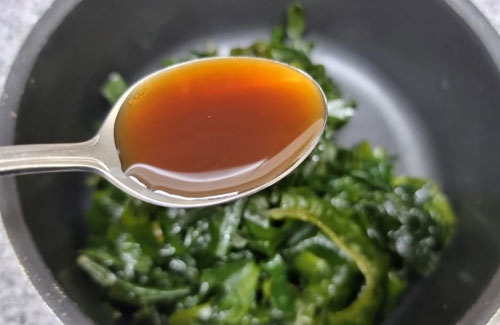
How do you usually make seaweed soup?
I used to add a spoonful of sesame oil or perilla oil and sauté the soaked seaweed well.
When you add beef, the savory aroma really comes up.
However, I've been hearing a lot lately that you shouldn't sauté seaweed in sesame oil or perilla oil.
There is a reason for this. Especially with perilla oil, you really need to be careful.
Perilla oil contains a lot of alpha-linolenic acid, which is an omega-3 fatty acid. This is one of the reasons we say perilla oil is good for you.
However, this fat can oxidize quickly when exposed to high temperatures and air for a long time.
But just because you've heated perilla oil once doesn't mean it suddenly becomes toxic. Sautéing it briefly while making seaweed soup won't cause any major health issues.The question is whether it's necessary to do it that way. If you're sautéing seaweed to the point where it smokes, then the components change, and that's a bit of a waste.
What about sesame oil?
Sesame oil contains antioxidants like sesamin and sesamol.
So, compared to perilla oil, it has relatively good oxidative stability against heat.
Therefore, it's best not to take the advice you sometimes see online that "heating sesame oil produces carcinogens, so you should never sauté it" too literally.
Sesame oil and perilla oil are not the same oil. Still, I've changed my method of making seaweed soup a bit.
Especially, I never put perilla oil in a hot pot from the start.
I first add the soaked seaweed and beef to the pot.
You can lightly cook it on low heat or add a little water to sauté it gently. Then, pour in water or broth and let it simmer.
Seaweed soup ultimately needs to be simmered for a long time to develop flavor.
If you need a nutty aroma, you can add a little sesame oil at the end.
You can add it just before turning off the heat, or you can drop a few drops into the bowl after serving, and it smells great.
The same goes for perilla oil. It's better to add it to the finished dish rather than sautéing it over high heat.
Also, storage of perilla oil is important.
Buying a large bottle and keeping it in the kitchen for months isn't ideal. The longer it is exposed to heat, light, and air, the more likely it is to oxidize.
Make sure to close the lid immediately. If the product says to refrigerate, it's best to keep it in the fridge.
Buying smaller quantities and consuming them relatively quickly is also a good idea.
There's no need to worry about having sautéed seaweed in perilla oil while making seaweed soup in the past.
My mom did it that way, and I've lived that way too.
But now that I know, I think we should avoid sautéing perilla oil over high heat unnecessarily.
 ShareDonkey
 TamiaBooks







 Seattle - Emerald City |
 self-evaluation |
 Sandiego Auntie |
 Karina's Blog |
 Texas Real Estate Blog |
 PETRO Vatican Shrine |
 Bald Eagle Brothers |
 Real Estate Agent USA |
 Bacon King Blog |
  Stable Co. |
  Purple Moons, |
  International Court |
  roma |
  horse |
  moodansa 77 |
  zymit |
  maplefox |
  Fun Flex Life |
  hopeful |
  Reeno |
  Coastal city |
  meonetoo |
  Winter bear |
  Peach Jam Eating Laughter |
  Nando Raldo |
  American Man in a Mask |
  wendra |
  silver |
  bada2002 |