

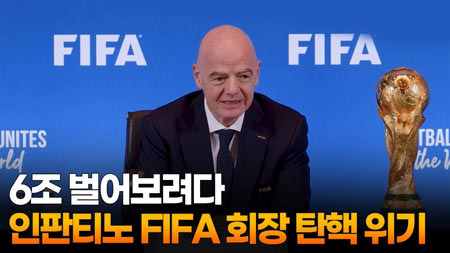
The 2026 North American World Cup was, in a word, the biggest money-making event in history.
For the first time, 48 countries participated, and there were a whopping 104 matches.
Over 6.81 million spectators attended the matches held in the United States, Canada, and Mexico. The stadium occupancy rate exceeded 99%.
Ticket prices were outrageous. From the start, soccer fans complained that they were too expensive, and good seats for the final went for several thousand dollars.
Still, people came to watch the World Cup. It was a tournament that clearly demonstrated how profitable soccer can be in the United States.
At the center of it all was FIFA President Gianni Infantino.
Infantino had been seen getting quite close to President Donald Trump leading up to this World Cup.
The frequent images of Infantino next to Trump and vice versa made it hard to tell whether he was the FIFA president or the chair of the U.S. World Cup organizing committee.
The problem arose after the World Cup was a resounding success.
FIFA pushed to bundle the commercial rights of the World Cup and other events into a separate for-profit company and sell shares to outside investors.
The plan was to value the new company at about $20 billion and sell a portion of the shares.
However, during the investment discussions, an investment firm led by Joshua Kushner, brother of Trump's son-in-law Jared Kushner, emerged.
This sparked outrage in European and other soccer circles.
The World Cup is not the personal company of the FIFA president.
The asset of the World Cup, held every four years, has essentially been created by soccer associations, players, and fans around the world.
But to hand it over to private investors in the form of shares to raise money?
From the perspective of European soccer, this crossed a significant line.
Ultimately, the plan was withdrawn, but the fire did not go out.
Instead, Infantino's re-election became a contentious issue.
The Football Association of Wales officially declared that it would not support Infantino in the 2027-2031 FIFA presidential election, and opposition from European soccer grew.
What once seemed like a sure re-election suddenly began to waver.
The situation in the U.S. is even more interesting.
Reports from outlets like the New York Post suggest that a cornered Infantino is trying to reach out to Secretary of State Marco Rubio to gain U.S. support.
However, the U.S. State Department responded that there are no plans for such a call.
Reports indicate that Infantino's relationship with President Trump, which had been so close, is no longer the same.
There are even stories that Infantino attempted to contact Trump regarding the World Cup commercial rights issue but has not been able to connect.
From a soccer fan's perspective, it's quite strange.
The 2026 World Cup should have been Infantino's crowning moment.
The expansion to 48 countries was successful, attendance records were broken, and expensive tickets were sold. Based solely on FIFA's ability to make money, Infantino could be considered one of the most successful presidents in history.
In fact, due to these financial achievements, there are still many supporters of Infantino in Africa and South America.
But perhaps it was that very success that made him more greedy.
In trying to turn the golden goose that is the World Cup into a financial product and sell parts of it to investors, he seems to have turned the entire soccer community against him.
He may have thought that by getting close to Trump, he had gained political power, but friendships in politics often last only until they are needed.
As the FIFA presidency wavers, it would be quite alarming for Infantino if those who seemed close just yesterday began to distance themselves.
Ultimately, whether this is a case of self-inflicted consequences or political downfall remains to be seen.
However, one thing seems clear from a soccer fan's perspective.
After creating the largest soccer stage in history with the 2026 World Cup and using that success as a springboard to seek even greater profits, he has put his own position at risk.
In soccer, there are times when teams push forward to score one more goal, only to get hit by a counterattack.
Right now, Infantino seems to be in just that situation.
 AZCowboy
 LifeIsTiming
 MacaronDreamr







 There Are Such Things in the World |

 Seattle - Emerald City |
 Next Year, Let's Become Rich |
 Strawberry Candy Smoothie |
 Infinite Style |
 Living Economy Information Blog |
 Koreab Date |
 Only Dentalbay |
 US Home Buying Information Home Insurance |
  torvik |
  charger |
  holy cheese |
  Pleasant K |
  Rolling Joy Life |
  lidus |
  French Macarons |
  Central Intelligence Agency Deputy Director |
  ATL Power 1 |
  MP Forever |
  Soy Angelino |
  San Jose Pop |
  Pronunciation Yo |
  hamooo |
  Entip |
  Yavrix 92 |
  cherry cherry |
  Coastal city |
  Mazinger Z Rocket Punch |