
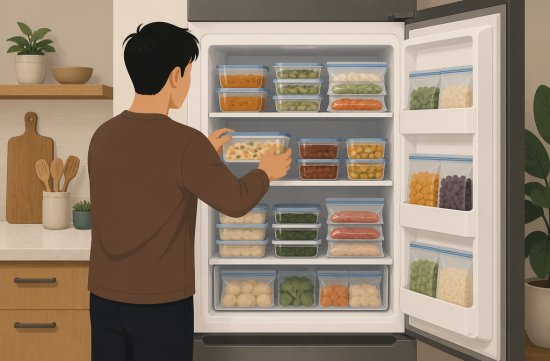
I recently heard from a friend about a family that fills their freezer every weekend.
They set aside one Sunday to make several times the usual amount of soups or stews, portion them out, and freeze them, so during the week, they just have to heat them up.
Initially, they started this to save time, but after a few months, they noticed a significant drop in their food expenses when looking at their credit card statements.
After about three months, their food receipts had changed dramatically, and this wasn't just a feeling; it could be explained with numbers.
According to analysis from the U.S. Department of Agriculture, about 25 percent of the food purchased by households ends up being wasted. For a family of four, that amounts to throwing away between $1,365 and $2,275 each year.
This is where bulk freezing shows its effectiveness. Since vegetables and meats that would spoil in the fridge are reduced, waste is minimized from the start.
In fact, research on households that increased their use of frozen foods instead of fresh ones found that food costs dropped by nearly 30 percent, and food waste decreased by 47.5 percent.
The habit of planning meals in advance and cooking in bulk also has a significant impact. Studies show that households that plan their shopping and cooking save about 15 to 25 percent on food costs compared to those that don't.
I found another similar case where a family of four that used to spend about $220 a week reduced their expenses to around $170 by bulk cooking on Sundays, switching to some store-brand products, and cutting back on dining out. This shows a reduction of about 23 percent, indicating that the earlier mentioned 30 percent isn't an unreasonable figure.
In times like these, when grocery prices are continually rising, the difference can feel even more significant. Recent consumer price index data shows that grocery prices have increased by 2.7 percent compared to a year ago.
I tend to feel more at ease when I can confirm things with calculations rather than just feelings, so after hearing this, I took a closer look at the method.
The key was surprisingly simple. Choose dishes like meats or soups that don't lose much flavor when frozen and thawed, and prepare not just two servings but six to eight servings at once.
As the quantity increases, buying ingredients in bulk lowers the unit cost, and by portioning and freezing them, you can take out only what you need without worrying about expiration dates, naturally reducing waste.
All you need is a few airtight containers or freezer bags, so the initial cost is minimal.
As an additional tip, it's quite important to label the containers with the cooking date and menu. If you can't keep track of what's in the freezer, you might end up buying more without realizing it, which is also a form of waste.
If family members have different tastes, it can be efficient to freeze sauces or seasonings separately and add them according to each person's preference just before cooking.
However, not all dishes are suitable for freezing. Avoid items like salads or fried foods where texture is crucial, and start with soups, curries, or stews to minimize the risk of failure.
Regardless of how one views food price policies, everyone feels the burden of grocery costs has increased, and addressing the variables that can be controlled at home seems to be the most realistic response.
This experience has reaffirmed that changing just one method of utilizing the freezer can have a more significant impact on actual spending than grand saving strategies.








 Anna Life |
 JESIKYEOALBA BLOG |
 Dad's Tribute TC |
 Glow Yo |
 U.S. Retirement Pension Information |
  Exploring American Life Information |
 Choco Choco Star |
 Soy Angelino |
 Conflite Teacher |
 Yahoo LALA |
  Fruitop |
  sing sing |
  ORAVEZIN Oppa |
  Lego My Ego |
  logger |
  summita |
  Ari Songhan American Immigration Life |
  marketbox |
  Investment Campus Home Ownership |
  yentra |
  Iowa Egen Aunt |
  donut33 |
  gravity |
  American Golf Course Travelogue |
  There Are Such Things in the World |
  Agenda Center |
  digital |