

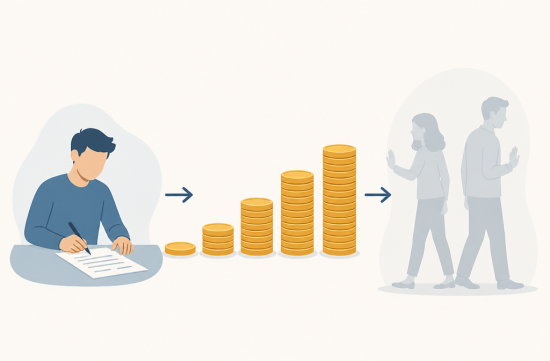
Last week, while waiting in line at a local coffee shop, I overheard a student who looked to be around twenty talking to a friend. "I signed that document by myself. My parents' names aren't even on it." Curious about what kind of loan they were discussing, I listened closely and found out it was about student loans.
I paused at this point. How can an eighteen or nineteen-year-old, with no significant bank account or credit history, sign a document for thousands of dollars all on their own? Intrigued, I went home and did some research. Since this is a neighborhood with a high college enrollment rate, I often hear similar stories, but most people only have a vague understanding of the structure involved.
It turns out the structure is designed that way. The federal student loan known as Direct Loans is issued solely in the student's name. There's no credit check, and no co-signer is required. Entering parental income information on the FAFSA is just a procedure for calculating grants and loan limits; it doesn't mean the parents are responsible for repayment. Since there's no space on the forms for a parent's name, the student signing alone isn't an exaggeration.
On the other hand, the Parent PLUS Loan, which parents borrow directly, does require a credit check. What happens if there are issues with the parent's credit history, or if the application is outright denied? In this case, the student can qualify for a higher unsubsidized loan limit that applies to independent students. For first-year students, those receiving parental assistance can borrow up to $5,500 annually, but if the parents are out of the picture, that limit increases to $9,500. It's ironic that the moment parents step back, the amount of debt the student takes on actually increases.
Furthermore, there are cases where parents don't fill out the FAFSA at all, or where there are circumstances that sever contact with the child. The process for recognizing these special circumstances is complicated and varies by school, leading many students to turn to private loans without co-signers. The problem is that these loans tend to have higher interest rates. I've heard several stories of students who were shocked to learn that interest continues to accumulate while they are still in school.
Looking at actual numbers made the situation clearer. Among graduates with a bachelor's degree in 2024, 47 percent had student loan debt, with an average balance of $29,560. For federal loans alone, the average balance at graduation was $20,460, while private loans averaged $42,170, nearly double. I suspect that students who are pushed into higher-interest loans due to the lack of a co-signer are significantly contributing to this gap.
This isn't about blaming one side politically. Both those advocating for lower tuition and those wanting to reform the loan system have their reasons. However, when examining the system itself, it's clear that young adults are left to shoulder significant legal responsibilities without any credit history as soon as they turn eighteen. It's fascinating yet concerning that while it's difficult to get a car loan, the barriers for student loans are surprisingly low.
I never expected that brief conversation I overheard in the coffee shop would stick with me for so long. Today, I record this moment from everyday life. Whether parents are present or not, it's important to remember that the hand signing those documents ultimately belongs to the student. Before making a significant decision, it would be beneficial to have an adult nearby who can help them understand exactly what those documents mean, as that alone could lead to a very different starting point.






 Conflite Teacher |
 Unknown Dog Walk blog |
 Khan Film Blog Production |
 Yoyma |
 breaddough |
 yenne |

 MAX009 BLOG |
 harper |
 logger |
  Anna Life |
  summita |
  Ari Songhan American Immigration Life |
  marketbox |
  Investment Campus Home Ownership |
  yentra |
  Iowa Egen Aunt |
  donut33 |
  gravity |
  American Golf Course Travelogue |
  There Are Such Things in the World |
  Agenda Center |
  digital |
  timemachine |
  Starry Eyes |
  Desert King |
  Texas Real Estate Blog |
  U.S. Retirement Pension Information |