
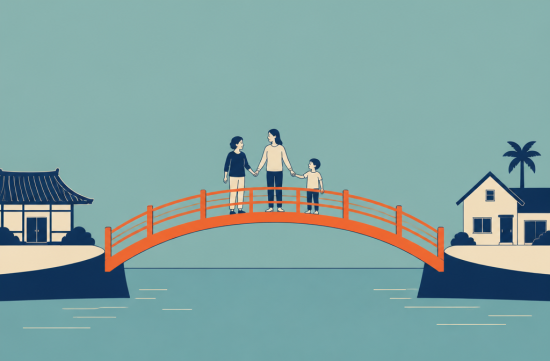
"My Korean is awkward, and my English isn't perfect either." The person who said this was a Korean American in his late thirties, who graduated from an American university and works at a respectable job.
Yet, that confession felt completely familiar. I've heard similar words countless times in church kitchens and at the checkout lines of Korean grocery stores.
We're talking about the generation that immigrated to the U.S. as children, often referred to as the 1.5 generation. Today, I want to share some important thoughts about those who stand in this 'in-between' space.
First, let's clarify where this term comes from. Surprisingly, it wasn't coined by the Korean community.
UC Irvine sociologist Ruben Rumbaut used the term 'one and a half generation' while studying Cuban immigrant youth starting in 1969. He himself was a young immigrant from Cuba.
Then, in the 1980s, while researching Southeast Asian refugee youth, the numerical designation '1.5' became established. The 1988 report by Rumbaut and Ima on San Diego refugee youth is often cited as a key starting point.
Simply put, it refers to those who were born in Korea but spent their adolescence and school years in the U.S.
They are neither fully 1st generation like their parents nor 2nd generation like those born here. Hence, the ambiguous number 0.5 is attached. In the Korean community, the term 'iljeomose' is now used very naturally.
Of course, not every 1.5 generation has the same experiences. Depending on when they arrived and where they grew up, their Korean language skills and the weight of their identity vary widely. A person who arrived at five years old and one who came at fifteen lived in completely different worlds.
Looking at the numbers makes it clear that this struggle is not just an individual issue. The Pew Research Center conducted a survey from July 2022 to January 2023, including 1,146 Korean respondents among Asian American adults.
57% of Korean respondents were foreign-born, meaning they were immigrants. This indicates that more than half of Korean Americans are people who came from somewhere else.
66% identified primarily as "Korean" or "Korean American." 20% said they identified as "Asian American," while 9% identified simply as "American."
Among all Asian Americans, 52% used their ethnic origin in their identification, indicating that Koreans particularly hold onto their roots.
However, there was one statistic that caught my eye. 25% of Koreans reported that they had hidden aspects of their culture or religious practices in front of non-Asian people.
That's one in four. This is higher than the overall average of 20% among all Asian Americans. I found myself staring at this point for a while.
You've probably heard stories about eating lunch in the bathroom because of the smell of kimchi. This isn't just an old tale. To hide something ultimately means feeling unsafe.
The challenges faced by the 1.5 generation continue at home. Parents have expectations rooted in Korean culture, while schools and workplaces evaluate them based on American standards.
There are many instances where a twelve-year-old had to read bank documents for their parents, interpret at the hospital, or directly communicate their grades during parent-teacher meetings.
Experts refer to this as 'language brokering,' meaning the child becomes the interpreter and secretary for the family. Adults often take this burden for granted. I have much to reflect on in this regard.
So, I want to say clearly: the 'in-between' of the 1.5 generation is not a flaw but the most precious bridge our community possesses.
Let me explain why. Who connects a grandchild who can't speak Korean with a grandmother who can't speak English?
The person who explains Medicare documents, school notices, and rental agreements to their first-generation parents is often from this generation. Many of the staff connecting first-generation immigrants with public services in Korean organizations, churches, and nonprofits are also 1.5 generation.
Therefore, society should not leave this bridge solely to individual sacrifice. I want to raise my voice on this matter.
If public institutions and hospitals properly provide Korean interpretation services, a twelve-year-old won't need to accompany their mother into the doctor's office.
If schools have sufficient bilingual programs and counseling staff, the instances of children hiding because of the smell of kimchi will decrease. I see this as a matter of investment, not cost.
There are also things that can be done at home. When your child says, "I feel like I'm neither Korean nor American," don't take it personally; listen to them fully.
Saying, "You are both," can be incredibly empowering. Cooking a bowl of Korean food together and talking can also be a great start.
To the person who initially made that statement, I responded this way: It's not awkwardness; it's holding both languages.
It's not a space that is neither Korean nor American, but a place that encompasses both Korea and America. I hope those who stand in that space can hold their heads a little higher.
 YogurtAI
 PuddingJoyMan







 moodansa 77 |
 Conflite Teacher |

 US Snowboard Information Exchange |

 There Are Such Things in the World |

 San Diego TOP Idol |
 productionblog |

 U.S. Military Recruitment Information |

 U.S. Weather Bureau News |

 fernando park |
 Shining Our Own World |
 Raymond K. |
 gravity |
 714 Success Era Real Estate |
 Investment Beginner Company Information Encyclopedia |
 musicque |
 The Gelaton |
 ovelion |
 Chicagonian |
 Freedom Yea |
 AZ Road Master |
 glenix39 |
 Something is popping in the situation |
 orvella |
 vella |
 comets |
 Banana |
 Yes Dorian |
 Minnesota Sonata N |
 zentar |