

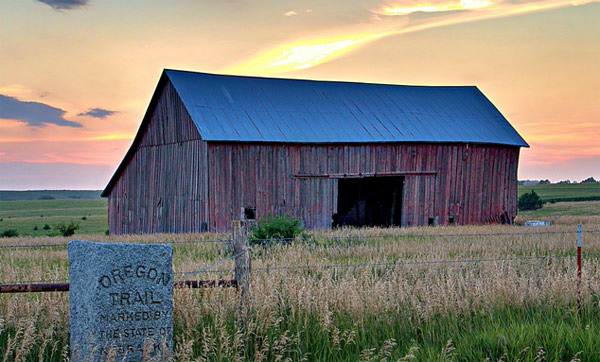
The stories of the Oregon Trail in Nebraska are records of the time when people moved in search of land and a future before the United States settled in the West. Although the name Oregon Trail suggests a path to Oregon, the core section of that journey was actually in Nebraska.
The reason is that the route to the West was relatively flat, and it was possible to travel along the river.
In the mid-19th century, pioneers living in the East loaded all their possessions onto wagons and headed west. Upon entering Nebraska, the first thing they encountered was the endless plains and the Platte River. This river was like a lifeline for the Oregon Trail.
It provided water, helped with navigation, and served as a reference point to avoid getting lost. Thus, pioneers repeatedly told each other, "Just follow the Platte River" as they moved along.
Another reason the Nebraska section was important was due to the prominent landmarks.
Chimney Rock, which still stands today, was almost like a landmark for the pioneers. Seeing the rock spire rising above the horizon gave them a sense of relief, as if to say, "Ah, we are on the right track." Many kept records in their diaries of that rock. Each day was a journey filled with anxiety, so the psychological comfort provided by a distant rock was greater than one might think.
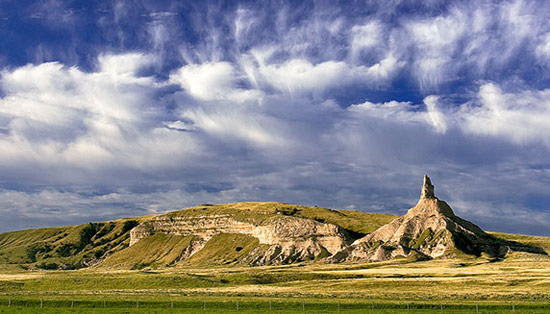
Further west lies Scotts Bluff National Monument.
This cliff area was like a highlight of the Nebraska Oregon Trail. After only seeing plains, the sudden appearance of the massive rock cliffs was overwhelming and also signaled that they were past the halfway point of their journey. However, this area was also prone to accidents. Wagons could tip over while crossing the ridge, and many lost their lives due to illness and accidents.
The Oregon Trail is often romanticized as a pioneering story, but the reality of passing through Nebraska was very harsh. In summer, there was heat and mosquitoes; in winter, cold and wind; and there was always a shortage of food and disease. Diseases like cholera spread rapidly along the river and were deadly for families traveling together. The grave markers scattered across the Nebraska plains tell us that the journey was by no means light.
Nevertheless, people did not stop. The reason was simple. They could not go back. They had already sold their homes, left their towns, and loaded everything they had onto the wagons. The endless plains of Nebraska were thus a frightening space. It was a land where they had no reason to turn back and no certainty to move forward, yet they had to advance day by day.
Now, when driving through Nebraska, one might think, "Was this really such a difficult road?"
The roads are straight, and the scenery is monotonous. Yet, it was within that monotony that hundreds of thousands suffered, were buried, and the survivors cried and rose again.
The Oregon Trail in Nebraska is closer to a record of silent survival than a glorious history. The expansion of the United States to the West was made possible by those who endured the endless plains. Thus, this path remains quietly, yet it has preserved the history of the past.






 Moscow Kim |
 coloradoman |
 Montgomery Mom |
 GOGO SING |
 Hajiwon Blog Hair Salon |
 selvon |
 moomoon |
 NE Hodori Preik |
 Nebraska Center Director TOP |
 Eagle in America for Five Years |
  Korean Mom |
  My NYC |
  moo moo |
  Mr Oh |
  forevergee |
  festival |
  manchester |
  constant |
  Leapfrog Move |
  vibranto |
  Tora Tora |
  yellowbutter |
  Dolly |
  US Embassy |
  NYC saladbar |
  Finding Superfoods |
  lightyear |
  song bang |
  vexomo |
  Indiana Jones |