
Some years ago, I experienced something firsthand: my blood pressure readings at the hospital were significantly higher than those taken at home, leading to a lengthy discussion with my doctor. I was curious why my readings were fine at home but spiked at the hospital. I even suspected that my device might be malfunctioning.
Since then, I've done some research and learned that I wasn't alone in this experience. Today, I want to share what I found.
First, there's a term for the phenomenon of having high blood pressure readings only at the hospital. It's commonly referred to as white coat hypertension.
Just seeing a doctor's coat can make you anxious. Waiting in the waiting room, feeling nervous, and rushing in from the parking lot can all contribute to elevated readings. It seems our bodies respond more honestly to our emotions than we realize.
I was surprised to learn that the opposite can also occur. This is often overlooked. When blood pressure is normal at the hospital but high in everyday life, it's called masked hypertension.
This means you can't rely solely on one set of numbers. That's why the American Heart Association (AHA) recommends that individuals with hypertension regularly monitor their blood pressure at home.
For reference, the AHA considers a reading of 130/80 or higher to be hypertension. If you remember only the older guidelines, it's a good idea to check this number.
However, it's important to measure accurately at home for the readings to be meaningful. Looking back at my initial mistakes makes me chuckle.
I used to take my readings while sitting on the couch, legs crossed, watching TV after having a cup of coffee. In hindsight, every aspect of my posture was wrong. It's no wonder my readings were inconsistent.
According to AHA and CDC guidelines, the basic principles are simpler than you might think. Let's go through them step by step.
First, avoid caffeine, tobacco, and exercise for at least 30 minutes before measuring. It's also a good idea to use the restroom beforehand.
Research shows that having a full bladder can raise your readings. It may seem trivial, but it can make a significant difference. If you're someone who measures right after getting up in the morning, pay special attention to this.
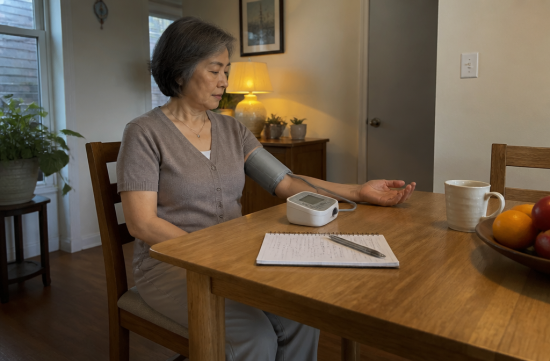
Second, sit in a chair with back support, keeping your feet flat on the floor. Don't cross your legs. A dining chair is much better than a soft couch.
Third, rest your arm on the table so that the cuff is at heart level. If your arm is hanging down or resting on your knees, your readings may be higher.
Fourth, the cuff should be placed directly on bare skin, not over clothing. Many people tend to wrap it over a thick sweater in winter, and I was one of them.
Fifth, don't measure immediately; sit quietly for a few minutes before taking your reading. It's best not to talk while measuring.
Taking a reading while on the phone or chatting with someone can lead to higher numbers. This is something many people do unconsciously.
Sixth, don't stop after just one reading; take at least two readings with a 1-2 minute interval in between. The CDC also advises measuring multiple times at the same time each day.
And make sure to record your readings. I write down the date, time, and numbers in a small notebook to take with me to the doctor. Nowadays, many devices can save this information in a mobile app, making it more convenient.
It's also helpful to set specific times for measuring, such as morning and evening. For example, measure after using the restroom in the morning and after a meal in the evening to establish your own routine.
The device itself is important too. If the cuff size doesn't fit your arm, good posture won't matter.
If the cuff is too small, it can give a falsely high reading, and if it's too large, it can give a falsely low reading. Measure the circumference of your arm between your elbow and shoulder with a tape measure to choose the right size. If the standard cuff doesn't fit, larger sizes are often available.
When purchasing a device, check if it's a validated product. You can find a list of validated devices on validatebp.org, and you can search by cuff size as well.
Generally, devices that wrap around the upper arm are recommended over wrist monitors. It's also a good idea to bring your new device to the doctor's office to compare its readings with the hospital's device.
I believe this is a matter of principle. The information about your body needs to be accurate so that you can have meaningful conversations with your doctor.
Especially for those who aren't comfortable with English, the anxiety can increase in the exam room. In such cases, having accurate records from home can be a reliable resource. Numbers don't require translation.
Everyone has the right to understand their health accurately. I always think that this right shouldn't be compromised due to language barriers.
However, you shouldn't make decisions about reducing or stopping medication based solely on home readings. Always consult with your doctor or pharmacist with your records in hand.
There's no need to worry too much if you get a high reading once. It's much more important to look at trends over days or weeks.
If I were you, I would start preparing a chair, a table, and a notebook from this evening. A small habit can provide more reassurance than you might expect.
 CrystalStone96








 zestorbit |

 hihihi |

 fruitflash |

 Anjollinya Blog |
 United States Army |
 ASURA |

 B.I.G. Victor |

 Mr Oh |


 Lim Ario |
 Lululala |
 Atlanta Business Information |
 Yo Lock Me Up |
 Joyce 77 |
 ANSLO NEWS |
 maplebyte |
 Shining Our Own World |
 Raymond K. |
 gravity |
 714 Success Era Real Estate |
 Investment Beginner Company Information Encyclopedia |
 musicque |
 The Gelaton |
 ovelion |
 Chicagonian |
 Freedom Yea |
 AZ Road Master |