
The air has gotten quite chilly in the mornings and evenings. The trees in the neighborhood have turned yellow and red, and before I knew it, half the leaves have fallen.
Tomorrow is Thanksgiving. This year, it falls on November 26, the fourth Thursday of November.
I stood in front of the frozen turkey section at the grocery store for quite a while. Next to it, the meat section was piled high with LA ribs.
Seeing that scene made me smile. A neighborhood where turkey and ribs are sold side by side—this is what Thanksgiving looks like for our Korean families.
When we first immigrated, Thanksgiving was actually quite simple. It was a day for families to gather and prepare a little more abundant Korean food than usual.
The turkey was big and unfamiliar, and it took several hours to cook. It must have felt quite strange for the adults to be checking the meat thermometer in front of the oven.
The change was mostly brought about by the kids. A child who made a pilgrim hat at school and drew a turkey would ask why we didn't have a turkey at our house.
I've heard that question before. The first year I bought a turkey, I didn't know how long it took to thaw, so I filled the sink with cold water the night before and anxiously waited.
Honestly, the result was dry. But when that brown lump was placed in the center of the table, the kids' faces lit up. Since then, I learned to start thawing it three days in advance in the refrigerator.
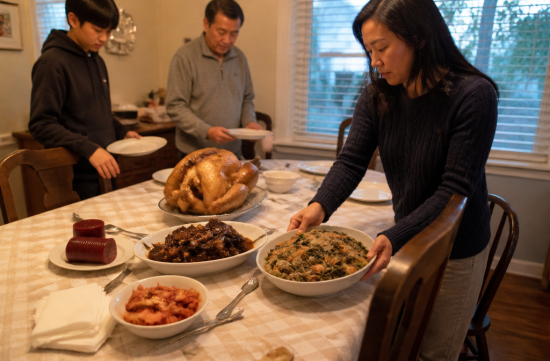
Even after the turkey came in, Korean food didn't disappear. Instead, a picture emerged where ribs and japchae took their place next to the turkey.
If you look for stories about Korean families featured in American media, you'll find many similar scenes. There's always braised ribs, japchae, and a plate of kimchi next to the dry turkey and canned cranberry sauce.
Some families even serve ribs or chicken as the main dish instead of turkey. There are families that switched to Korean barbecue during the pandemic and have kept that tradition.
The reason japchae is so beloved is simple. It doesn't change much in taste even when made in advance, and everyone from kids to adults, including guests who are new to Korean food, enjoys it.
The next step was mixing things up. Recipes started circulating for roasting turkey with soy sauce, ginger, and honey, and some families began glazing it with gochujang.
Interesting things are happening with the sides too. Dishes like kimchi mac and cheese and glutinous rice stuffing are posted on Korean blogs and recipe sites every year.
The fate of leftover turkey has also changed. Many families now make turkey kalguksu or porridge instead of sandwiches. I think that's a real lifesaver.
When you boil the bones well, the broth becomes much richer than you'd expect. Just adding zucchini and potatoes makes for a hearty breakfast the next morning.
These days, we're also seeing changes in the opposite direction. Second-generation Americans are bringing dishes like mashed potatoes and apple crisp to family gatherings.
Ultimately, the table setting hasn't flowed in just one direction. The parent generation has embraced turkey, while the children's generation has held onto ribs, creating a blend of both.
Let me share a realistic fact. According to a survey by the American Farm Bureau Federation (AFBF), the cost of a Thanksgiving meal for ten people this year is $58.63, which is a 6% increase from last year.
The biggest increase is in turkey. The average price of a 16-pound frozen turkey has jumped to $23.68, a 10% rise.
Fortunately, the South has the lowest prices regionally at $54.33. But everyone knows that adding ribs to the cart changes the total significantly.
So these days, I do it this way. I buy a smaller turkey or just roast the breast, and I reduce the amount of ribs while making plenty of japchae and jeon.
In fact, the dish that empties first at the table is always japchae. It's a relief that there's a dish everyone reaches for, even if it doesn't require expensive ingredients.
Sometimes I get asked this question: Is it okay to serve so much Korean food for an American holiday? I actually think that's closer to the original spirit of the holiday.
Thanksgiving is ultimately a day to give thanks for having made it through the year. The image of filling a table with the foods each person brings is a true reflection of the immigrant experience in America.
That doesn't mean we have to throw out the turkey. For the kids, that brown turkey represents a small sense of belonging as they celebrate the holiday with friends.
There's no right answer. Whether you serve just turkey, just ribs, or both, it's all our Thanksgiving.
This year, I will also place ribs and japchae next to the turkey. I've already planned to make kalguksu with the leftover turkey.
What dishes will be on your table this year? If you have your own combination, feel free to brag a little.
It's going to be a busy day with shopping and cooking, but I hope everyone has a warm and filling Thanksgiving. Happy Thanksgiving!
 OceanBuddy




 moodansa 77 |

 Conflite Teacher |

 US Snowboard Information Exchange |

 There Are Such Things in the World |

 San Diego TOP Idol |

 Gook Rule |

 Blondee |



 Lululala |
 Lim Ario |
 Mr Oh |
 Atlanta Business Information |
 Yo Lock Me Up |
 Joyce 77 |
 ANSLO NEWS |
 maplebyte |
 Shining Our Own World |
 Raymond K. |
 gravity |
 714 Success Era Real Estate |
 Investment Beginner Company Information Encyclopedia |
 musicque |
 The Gelaton |
 ovelion |
 Chicagonian |
 Freedom Yea |
 AZ Road Master |
 glenix39 |