

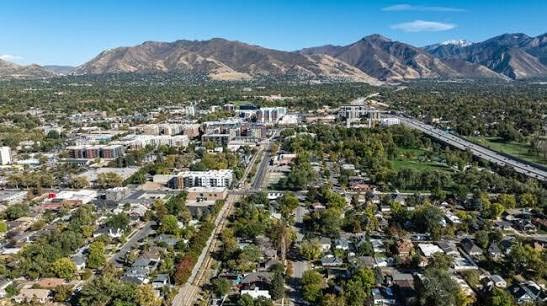
Some people are considering buying a house in Salt Lake City and renting it out.
Especially when comparing downtown condos to single-family homes a bit further out, it can be confusing to determine which option is more profitable.
For example, a downtown condo might seem easier to rent out, but the home prices and HOA fees are high. A single-family home in the suburbs may have a lower purchase price, but repair costs could be significant.
So the first thing to calculate is, "How much rent can I charge compared to the home price?"
The calculation isn't difficult. For instance, if you buy a $600,000 house and charge $1,600 a month in rent,
the annual rental income would be $19,200. Dividing this by the home price of $600,000 gives you about 3%. This is called the total return rate.
However, you shouldn't just think, "Oh, that's a 3% return." This is because no expenses have been deducted yet.
As a homeowner, you will need to pay property taxes first. You will also need homeowners insurance, and there may be periods when the house is vacant.
When tenants change, you may need to repaint or clean, and if appliances like the refrigerator, air conditioner, or water heater break down, the landlord is responsible for repairs.
If it's a condo, there are HOA fees as well. If it's $300 a month, that totals $3,600 a year. If you use a management company, rental management fees will also be added.
So in actual investments, you look at how much is left after deducting these costs.
A commonly used term here is Cap Rate.
Simply put, before considering a mortgage, this number shows how much income the house itself generates in a year.
You take the annual rental income and subtract property taxes, insurance, management fees, repair costs, and vacancy costs, then divide the remaining money by the home price.
For example, if you receive $19,200 in rent for the year but, after various operating expenses, you have $10,000 left, the Cap Rate for a $600,000 house would be about 1.7%.
When a mortgage is involved, the situation changes even more.
If you put down 20% on a $600,000 house, you would invest $120,000 and need to borrow about $480,000.
If the interest rate is around 6%, your monthly payment could be about $3,000 for principal and interest.
But what if you can only charge $1,600 a month in rent?
It would be impossible to cover the mortgage with just the rent received. Additionally, the landlord has to cover property taxes, insurance, and repair costs, meaning they would need to contribute extra money each month.
Such a property is not very attractive as an investment that generates immediate cash flow from rent.
One simple method that real estate investors often use is the 1% rule.
For a $600,000 house, the rent should be around $6,000 to meet the 1% rule.
Of course, finding such conditions in today's major cities is quite difficult. The 1% rule is not an absolute standard for whether to buy a house or not.
However, if a $600,000 house only rents for $1,600, it's clear that there is a significant gap between the purchase price and rental income.
That doesn't mean that investing in Salt Lake City real estate is necessarily bad.
In real estate, the money left over from rent is not the only profit. As tenants pay rent, the mortgage principal gradually decreases, increasing your equity.
If home prices rise in 10 or 20 years, you could also see capital gains.
So among those buying homes in Salt Lake City, there are investors who expect to hold onto the property for a long time, anticipating appreciation, rather than just looking to make $500 or $1,000 a month right away.
So which is better, a downtown condo or a single-family home in the suburbs?
Condos may be easier to rent if they are close to workplaces, universities, or hospitals, and they generally have less management burden. However, high HOA fees can significantly eat into profits.
Single-family homes in the suburbs have the advantage of potentially longer tenancies if families move in. However, if major repairs like roofing or HVAC issues arise, it can cost a lot at once.
Ultimately, when viewing properties, you shouldn't buy based solely on the feeling that "this house seems like it will appreciate."
You need to consider how much the house costs, how much rent you can realistically charge, how much property taxes and insurance will be, whether there are HOA fees, and calculate repair costs and vacancies, then finally see how much is left after deducting the mortgage.
In cities like Salt Lake City, where home prices have risen significantly, these calculations are especially important.
A good house and a good real estate investment are not the same thing. Even if a house is great to live in, if the purchase price is too high compared to the rent, it may not yield profits as a rental investment.
Ultimately, there is one crucial question.
It's not "Is this a good house?" but rather "How much is left for me after covering all the costs?"
If you calculate that number first, choosing an investment property becomes much easier.
 MorningSun
 GymForPhotos






 Smile Face |
 Helpful Life Stories |
 Casa Mia |
 Study Abroad Life Know-How Tips |
 pravix22 |
 AliAluAlo Blog |
 morvex37 |
 KGOMIO Blog |
 bravik31 |
 Utah, the Most Livable State |
  shadow 007 |
  sun walker |
  Choco Choco Star |
  midnight blue |
  honeypot |
  summer |
  adventure77 |
  flexible |
  Shintongbangtong Shin Naerin James Park |
  truepixel |
  Kathy's Blog |
  Hae Naem |
  quatspace |
  Marisol |
  Glassroom |
  Granola |
  joyfull yang |
  Olivia's Blog |
  Living in America and Writing Essays |
  Piano Teacher Blog |