
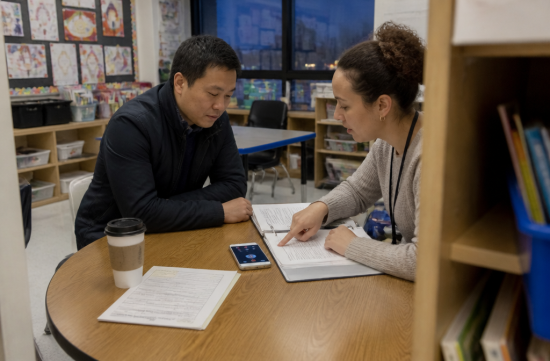
After work, I went out to the balcony with a warm glass of milk. The November night air had gotten quite chilly, and the winter constellations were slowly starting to appear in the low eastern sky.
As I looked at the stars, I remembered a story I heard a few days ago. A friend mentioned that they were losing sleep over the upcoming parent-teacher conference due to their English skills.
They were worried about only half understanding what the teacher said and just nodding along. They feared missing out on important discussions about their child's grades or friendships.
So today, I want to set aside the star talk for a moment and calmly organize the discussion about parent interpretation. To put it simply, if English is a burden, requesting interpretation is not something to be embarrassed about; it is a legitimate right of parents.
The basis for this is Title VI of the Civil Rights Act of 1964. This provision states that federally funded institutions cannot discriminate based on national origin, which includes public schools.
In addition, the 1974 Supreme Court ruling in Lau v. Nichols and the Equal Educational Opportunities Act established the principle that students should not be effectively excluded from education due to a lack of English proficiency.
Schools have been following guidance issued in 2015 by the federal Department of Education and the Department of Justice, which stated that schools must communicate in a language that non-English speaking parents can understand.
However, the atmosphere changed a bit last year. Executive Order 14224, which designated English as the official language, was issued in March 2025, and the Department of Justice rescinded the language assistance guidelines that had been in place since 2002 on March 21 of that year.
Then, in August 2025, the Department of Education withdrew the aforementioned 2015 guidance. After hearing this news, many people wondered if they could no longer request interpretation services.
From what I found, that is not the case. What was rescinded was the guidance on how to interpret and apply the law, not the laws themselves, such as Title VI or the Equal Educational Opportunities Act.
Various educational and legal organizations emphasize the same point. The laws remain unchanged; only the federal government's enforcement intentions have shifted.
Of course, there are valid concerns. In schools with tight budgets, the absence of guidance could lead to a quiet reduction in interpretation services.
Personally, I understand the emphasis on English as a common language. However, I believe that parents not understanding during discussions about their child's education is a completely different issue.
Fortunately, Maryland has separate provisions at the state level. Parents of children receiving special education can request that completed IEP documents be translated into their native language, and according to the state education department's guidance, this request does not necessarily have to be in writing.
The state education department is also pushing for new regulations that will require each school district to develop language access plans by 2025. The draft includes provisions for planning, training interpreters and staff, and gathering user feedback.
I have not been able to confirm when these regulations will officially take effect. Therefore, it is best to ask your child's school directly about this matter.
Let me share a bit about what happens on the ground. According to the Baltimore County Public Schools guidance, it states that if interpretation is needed, parents should inform the school.
When indicating the required language, it mentions that parents can use the I Speak card or language support card. Just pointing to Korean on the card is a good start.
Baltimore City Public Schools also announced that all schools will have access to phone interpretation services this school year. The method involves the teacher and parent using a speakerphone with an interpreter in between.
So how should one proceed in practice? If I were a parent, I would send a brief email to the homeroom teacher or school office as soon as the conference date is set, stating that I need a Korean interpreter.
One sentence in English is sufficient. Just writing, "I would like to request a Korean interpreter for the parent-teacher conference," conveys the message clearly.
The district guide indicates that if you want to call an interpreter through a service, you may need to apply a few days in advance. Therefore, it's better to allow at least a week rather than waiting until the last minute.
Additionally, I recommend not assigning the interpretation task to your child. It can be difficult for a child to relay their grades or personal issues to their parents, and it can also be quite a burden for them.
Writing down questions you want to ask in Korean beforehand can also be helpful. Narrowing it down to just three topics, such as grades, homework, and friendships, can make the conversation much more solid.
If you request interpretation and the school says it's difficult, what should you do? First, try contacting the vice principal or the district's multilingual support department again, and if that doesn't work, you can seek help from local Korean organizations or legal aid groups.
Many parents are also curious about whether they have to pay for interpretation services. So far, most schools have provided them for free, but since each district may operate differently, be sure to ask about potential costs when making your request.
After finishing my milk and looking up at the sky again, the stars were still shining in their places. I thought that even if the guidelines change, the desire of parents to understand their children remains the same.
Even if English is not strong, the right to know about your child's school life is the same. Don't hesitate to request interpretation for this conference.
 Garcon1980




 rissa |

 Gomo Nim |

 lattepop |

 Well Done Sir |

 butter 90 |

 frostpup |

 cocoakitten |

 maryland park |


 milkbear |
 havero70 |
 sasga now |
 Reno Cop |
 seouljung |
 bayaa |
 Coastal city |
 Good Hotels |
 heartwarming |
 Blogging with a Heart Like the Sun |
 peace |
 The Bread Lover Runs on Bread |
 yogurt 1 |
 Macon Boy |
 Joyce 77 |
 The Yellow |
 bluebird |
 Epoca News |
 Samttugi Grasshopper Noodle |
 kansan55 |