

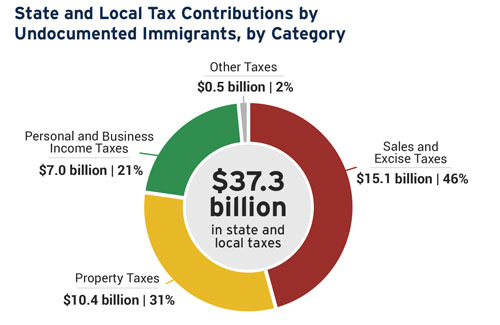
Living in Dallas, you often come across families who, despite lacking immigration status, diligently pay taxes while raising their children. Particularly, there are many cases where the parents are undocumented but the children are born in the U.S. and are citizens.
For such families, the recent IRS tax refund regulations are hard to overlook.
The Treasury Department and IRS proposed new regulations on August 19, which state that the refundable portions of four tax credits—Child Tax Credit (CTC), Earned Income Tax Credit (EITC), American Opportunity Tax Credit (AOTC), and Adoption Tax Credit—will be considered federal public benefits.
Importantly, this does not mean that all tax credits will be eliminated.
For example, consider a person who owes $2,000 in federal income tax but is eligible for a $4,000 tax credit. Until now, if they met the conditions, they could eliminate the $2,000 tax liability and receive a refund for part of the remaining amount.
The issue with the new regulations lies in this remaining refundable portion.
The Treasury views this not as a simple tax adjustment but as a federal public benefit provided by the government. Therefore, individuals who are not U.S. citizens, U.S. nationals, or qualified aliens as defined by law will not be able to receive this refundable portion. Permanent residents, refugees, or those granted asylum may qualify as qualified aliens.
So, what happens if the parents are undocumented but the child is a U.S. citizen?
This is likely the most pressing question for many Korean immigrant families.
Just because a child born in the U.S. is a citizen does not automatically grant undocumented parents eligibility for refunds. The proposed regulations assess the taxpayer's own eligibility when claiming a refund. In other words, even if the child is a U.S. citizen, if the parent filing the tax return does not meet the qualifications, the refund may be limited.
In simpler terms, it becomes difficult to assume that "since our child is a U.S. citizen, we can naturally receive the Child Tax Credit refund."
However, there is an important exception for joint tax filing.
If one spouse is a U.S. citizen, U.S. national, or qualified alien, the proposed regulations include an exception allowing the refundable portion in joint tax filings.
For instance, if the husband is undocumented but the wife is a U.S. citizen and they file jointly, the situation may change. However, if both spouses are undocumented and only the child is a U.S. citizen, the child's citizenship alone does not create eligibility for the parents' refund.
This can make a significant difference in real life.
Considering low-income immigrant families in Dallas raising two or three children while working in restaurants, construction, cleaning, or service industries, the tax refund amounting to thousands of dollars is not just a bonus. It can cover car repairs, overdue rent or utility bills, and expenses for children's clothing or school supplies.
Therefore, if these regulations are finalized, the individuals most directly affected will not be those who do not pay taxes at all, but rather those who work and file taxes but are not recognized as qualified aliens due to their immigration status.
One more thing to keep in mind.
Currently, this is not a finalized law but proposed regulations. We still need to see what the final regulations will look like. According to the IRS, if the final regulations are announced, they are proposed to take effect from the tax year ending after the announcement date.
Ultimately, for undocumented parents raising U.S. citizen children, the likelihood increases that "the child's citizenship and the parents' tax refund eligibility are separate issues."
In the U.S., many undocumented immigrants have worked and filed taxes, and families with U.S. citizen children have benefited from various tax regulations. However, this proposed regulation seeks to directly link refundable credits to immigration status.
In cities like Dallas, where there are many immigrant families, this issue is not as distant as it may seem.
If the final proposal passes as is, the refund amounts that ordinary immigrant families in my community receive during tax season could change significantly.
 SilentGoddess
 SodaQueen







 Folding Instructions |
 yentra |
 Cali M Law Group |
 quanta7 |
 Helpful Life Stories |
 xylora |
 Aura-Infused WACAM |

 wendra |
 Dallas Fort Worth DFW |
  novapixel |
  mortrix |
  ollege Mom |
  Esther 1983 |
  Arizona AZ Cowboy |
  fortbliss |
  Moscow Kim |
  My Two Way |
  toastyfox |
  FLORIDA Acus |
  tracker |
  TONTON COFFEE |
  sunrise |
  ultron78 |
  uplifted |
  same same life |
  USA Hyundai Kia |
  morvex37 |
  BOL SA RAM |