
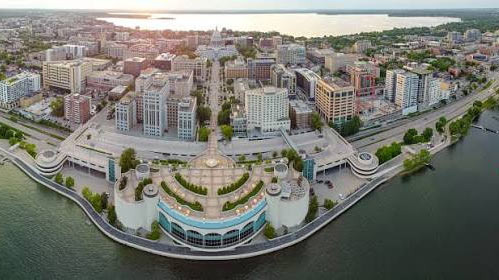
A friend who just moved to Madison called me and asked why the highways don't go straight through the city on the map.
That's a valid observation. The downtown area of Madison, located on a peninsula between two lakes, cannot accommodate interstate highways like I-90/I-94 directly passing through. Therefore, the US-12/US-18, known as the Beltline, serves as the main road that effectively traverses the city. This is where all the stories about Madison traffic begin.
The Beltline is a highway that connects the southern part of Madison east to west over a stretch of about 10 miles. This route handles over 120,000 vehicles daily. The problem is that this is essentially the only major bypass road in the area. The intersections at Park Street, Fish Hatchery Road, and Verona Road (US-151) are the most congested key points. Especially between 4 PM and 6:30 PM, traffic heading toward Verona Road experiences severe delays. This is due to the fact that Epic Systems' headquarters is in Verona, coinciding with the departure times of 13,000 employees. The same reason applies to the morning rush hour between 7 AM and 8:30 AM. WisDOT is currently conducting a long-term improvement study for the Beltline and is reviewing traffic relief options for a stretch of about 20 miles, including Verona Road.
On the public transit side, there was a significant change on September 22, 2024. Metro Transit launched Rapid Route A, Madison's first BRT (Bus Rapid Transit) line. This route, which cost a total of $195 million, was mostly funded by federal grants. Electric articulated buses use dedicated bus lanes and separate stops to quickly connect east and west. They can carry 50% more passengers than regular buses and have much higher punctuality. The north-south BRT Route B is aiming for a 2028 launch and is working on securing federal funding. Within the UW-Madison campus, the university's own shuttles and Metro buses operate frequently.
To be honest, living in Madison without a car can be quite inconvenient. While buses and bicycles are sufficient near the downtown and UW campus, it can be difficult without a car in the suburbs or shopping areas. Whether the opening of Rapid Route A will be a game changer remains to be seen. However, it definitely feels like things are improving compared to before. The days when friends looked at you strangely for taking the bus during rush hour on the Beltline are over. At least in Madison, that is.
The bicycle infrastructure is also worth mentioning. Madison is quite well-known as a bike-friendly city. There are well-established bike paths connecting the campus and downtown, and there are people who ride bikes even in winter. Of course, riding a bike on snow-covered roads requires courage, but from spring to fall, biking to work is a realistic option. The long-term solution that WisDOT is studying for the congested areas of the Beltline includes a stretch of about 20 miles from Middleton to Cottage Grove, and they are considering improvements at the Verona Road intersection and the introduction of a congestion alert system as short-term measures.
While changes won't happen overnight, the direction is correct. Madison is not a city that ignores traffic issues; at least it is a city that invests in trying to solve them, which gives hope for long-term improvement. There is also a university shuttle service for UW-Madison students and staff, and electric scooters and bike-sharing services are active around downtown and the campus.
Ultimately, the most realistic way to reduce traffic stress in Madison is to find a place to live near your workplace. If Epic is in Verona, then live near Verona; if UW-Madison is your destination, then near the campus. Madison is a car-centric city, but with the right placement, there are neighborhoods where you can live quite well without a car. The opening of Rapid Route A is expanding that possibility a bit more.
 HairyPoppins







 American Hardcore Band |
 Rice Shop Uncle BLOG |
 Baguette Blog |
 solvix18 |
 novapixel |
 winter |
 marketbox |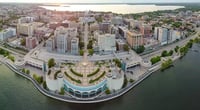
 planeto |
 My Love Bambino Alaview |
  coloradoman |
  lumora |
  Valley Bang |
  pravix22 |
  Cohesive Kong |
  werehere |
  problemo |
  galaxy88 |
  breezelove |
  Minnesota Sonata N |
  hazelnut |
  Korean News American Blog |
  AH LALA |
  Savion |
  pintos |
  Good Good |
  oh my salami |
  Lemonade Cider Planning Director |
  Way to easy |