
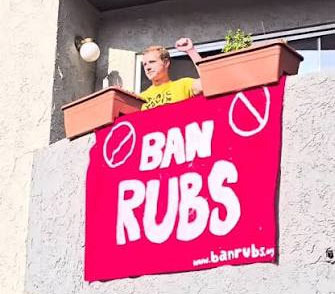
If you've lived in an apartment in LA's Koreatown for a long time, you know that costs like water, trash, and sewer fees can be a concern beyond just the rent.
Recently, some apartments have seen tenants outright refusing to pay these fees due to this issue.
The problem lies with RUBS (Ratio Utility Billing System), which can be simply described as a method where the total utility costs for the building are divided among tenants based on certain criteria.
Usually, if you have separate meters for electricity or water in your unit, it's straightforward. If you used 100, you pay 100. However, in older apartments, there may not be individual meters for each unit. In such cases, the total water bill for the building comes in at once, and the management company or a specialized agency applies criteria like apartment size or number of residents to divide the charges among the units.
It sounds reasonable in theory, but it creates issues in real life.
For example, let's consider two identical 2-bedroom units. One unit has a single 30-year-old man living alone, using one room as a home office. He showers in the morning, works during the day, and has a simple dinner in the evening.
In the adjacent 2-bedroom unit, however, there are six adult men living together. Six people shower daily, do laundry, and use the bathroom. Naturally, the water usage will differ significantly.
But if they are charged similar water fees just because the apartments are the same size, it would be frustrating for the person living alone.
In the Virgil Square Apartments near Virgil and 4th in LA's Koreatown, tensions have risen over this shared utility billing issue.
One resident claimed that when they moved in, the monthly utility cost was about $50, but after a few years, the combined bill for trash, sewer, and water rose to $182. That's a significant amount over a year. Just ten years ago, trash and water were free in the apartments.
What's more frustrating is the difficulty in verifying how that amount was calculated.
Residents have requested to see the original building-wide bill and the calculation method for each unit, but they have not received sufficient information.
Similar complaints have emerged from other LA apartments. If the rent is set at $3,400, but the shared costs for water and heating have jumped from $332 to $541 in a few months, it disrupts the tenants' budgeting.
Landlords also have their points. Installing new water meters for each unit in an old building can require extensive plumbing work and incur significant costs.
If the shared billing method is eliminated, there's the practical issue of how to divide the overall water and sewer costs for the building.
Therefore, I believe the more important issue than RUBS itself is 'transparency.'
Tenants should at least be able to verify how much the total water bill for the building was this month, how many units are sharing it, and what calculation method was applied to their unit.
If the water used in the pool or common facilities is included, that should also be disclosed.
The biggest problem with the shared utility method is that there is no accurate connection between how much I actually used and how much I pay.
If a 2-bedroom unit with one person is calculated similarly to a 2-bedroom unit with six people, it's no surprise that complaints arise.
Individual meters are the cleanest solution, but if that's not feasible, at least the calculation method should be made clear and understandable for everyone.
 joyfulroadwalker2008
 DrKimGroove







 Folding Instructions |
 yentra |
 Cali M Law Group |
 quanta7 |
 Helpful Life Stories |
 Weekend Movie Blog |
 Beauty, Health, Lifestyle Blog |
 coloradoman |
 Superman Cat Blog |
 Awesome Blog |
  novapixel |
  mortrix |
  ollege Mom |
  Esther 1983 |
  Arizona AZ Cowboy |
  fortbliss |
  Moscow Kim |
  My Two Way |
  toastyfox |
  FLORIDA Acus |
  tracker |
  TONTON COFFEE |
  sunrise |
  ultron78 |
  uplifted |
  same same life |
  USA Hyundai Kia |
  morvex37 |
  BOL SA RAM |