
This morning, while brewing coffee, I looked out the window and saw wet leaves piled up on the edge of the roof gutter. Since the rain had stopped, water was flowing over the edge in a steady stream.
That moment reminded me of last winter. I recalled the scene where icicles as thick as my forearm hung down from the eaves, sparkling like glass at sunset, making me gaze at them for a while.
Back then, I thought it was just a winter picture, but it turned out to be a pretty dangerous signal. So this time, I decided to look into it properly without delay.
First, let me clear up a misunderstanding. Just because leaves are piled up in the gutter doesn't mean that ice dams will form solely because of that.
According to university extension materials, the root cause of ice dams is the heat escaping from the house into the attic. When the roof warms up, the snow melts, and that water refreezes at the cold edge of the eaves.
Michigan State University Extension also concludes that to prevent ice dams, you need to fix the real causes, which are lack of insulation or ventilation. Ice dams can form even in houses without gutters.
So, is a gutter filled with leaves okay? Not really. It actually exacerbates the problem.
If the melted water has nowhere to go, it pools at the edge of the eaves and freezes overnight. When ice forms on top of wet leaves, the inside of the gutter can become almost a solid block of ice.
As snow falls, melts, and refreezes repeatedly, the weight continues to build up, which can cause the gutter to sag or detach from the wall. Icicles hanging from the gutter can loosen the fixed parts, posing a risk of falling.
What's even scarier is when water has nowhere to go. If water overflows from a blocked gutter and seeps under the roof boards, it can wet the attic, insulation, and wiring.
It's also common for water to flow down the walls and pool next to the foundation of the house. If moisture gets trapped in the walls or ceiling, it can lead to mold.
I've heard that many people discover yellow stains spreading on their ceilings only in spring, which sent a chill down my spine. It's like nothing happens all winter, and then it suddenly bursts out.
If you're not confident about climbing up to check, you can learn a lot just by watching the gutter from outside on a rainy day. If water is overflowing from the edges or if the area under the gutter is quiet, it means something is blocked.
So now, in late autumn, is the perfect time to take action. After most of the leaves have fallen and before the ground freezes, it's most efficient to clear them out.
If doing it yourself feels daunting, you can hire a service, but the prices can vary more than you might expect.
According to HomeAdvisor's 2025 data, American homeowners typically spend between $119 and $234 on gutter cleaning, with an average of $168. In terms of length, it's about $0.95 to $2.25 per foot.
The price increases significantly as you go up to the second or third floor. The height of the ladder and the difficulty of the job directly affect the cost.
I was momentarily stunned when I received the estimate. I thought, "Is it really this much just to remove a handful of leaves?"
However, considering the costs of roof repairs or dealing with ceiling mold, it ultimately feels like a cheap insurance policy.
How to dispose of the leaves you've cleared is also a surprisingly important detail. According to city guidelines, leaves must be placed in city-designated carts or special paper bags.
A single paper bag costs $2.75, and a bundle of five is $13.75. If you use a cart, you need to attach a yellow tag for each collection, which costs $6.50.
Each bag should not exceed 30 pounds, and you must place them at the curb by 7 AM on collection day. Remember that sweeping leaves into the street or near storm drains is prohibited.
Yard waste collection is scheduled from the first week of April to the second Friday in December. This year, that's December 11, but it can change depending on the weather, so it's a good idea to check the city website again.
If you've cleared the gutter, be sure to check the end of the downspout as well. If water falls right next to the house, it can easily seep into the foundation.
Angi recommends keeping the downspout at least 4 to 6 feet away from the house, with some suggesting more than 6 feet. It's a simple fix with an extension pipe, so it's not too burdensome.
And if your house tends to have severe icicles every year, don't just blame the gutter; have the attic insulation and ventilation checked. The causes can vary depending on the structure of the house, so it's best to have a professional take a look.
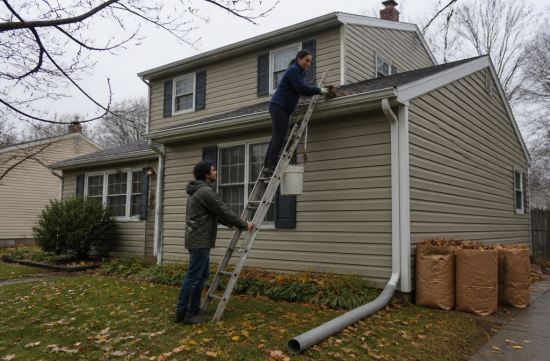
When working on a ladder, it's better not to do it alone; have someone hold the ladder from below. Wet leaves can make the steps surprisingly slippery, and it's best to avoid climbing directly onto the roof whenever possible.
This weekend, I plan to put on gloves and pull out the ladder. I'll have a calm piano piece playing in my earbuds.
As I scoop up handfuls of wet leaves under the cloudy sky, I strangely feel like I'm clearing out some of the clutter in my heart as well.
Winter always arrives quietly. This year, I want to watch that quietness from my window without worry.
 goldencloudtraveler1912
 VelvetField87







 Anjollinya Blog |

 Kitchen Ideas |

 Spaghetti Flying Religion |

 Giant Squid and Sweet Potato Soup |

 choi family |

 icotla |

 apricotla |


 oneonly |

 ssome |
 skykong |
 Shining Our Own World |
 gardener 007 |
 golfmaster |
 Nanana Nanana Nanana |
 Who's watching? |
 endone |
 RockStar |
 Casa Mia |
 You Only Live Once |
 Hardworking CPA |
 Joyce 77 |
 Runner Kim |
 My Town My Way Blog |
 My Miami Stories |
 Entip |
 Tony Park |
 DJ DC BLOG |