
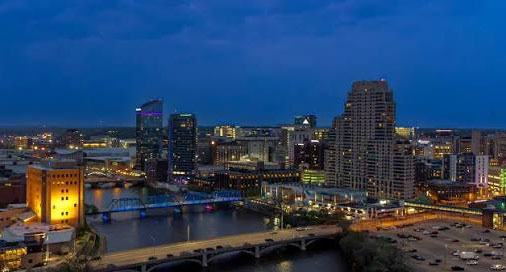
Grand Rapids may seem like a small city in the Midwest, but it actually serves as a significant economic, medical, and educational hub in western Michigan.
From the perspective of immigrants, particularly those from Asia, I have honestly outlined the pros and cons of living in this city. Of course, experiences and situations may vary, but I hope this serves as a reference for those considering settling here.
Pro #1: Economic Accessibility and Job Market are favorable. The economy of Grand Rapids is diversified, focusing on healthcare, pharmaceuticals, manufacturing, logistics, education, and services. Major employers such as Corewell Health, Meijer (supermarket chain headquarters), Amway Corporation, and Steelcase (the world's leading office furniture company) operate out of Grand Rapids. There are relatively open job opportunities for professional immigrants such as healthcare workers, IT specialists, engineers, and accountants, and the unemployment rate has remained lower than the Michigan state average.
Pro #2: Relatively Low Cost of Living. Immigrants who have moved from major cities on the East and West Coasts commonly mention that the cost of living in Grand Rapids is noticeably lower. Housing purchase costs, rent, grocery prices, and insurance premiums are all lower, allowing for a much more comfortable lifestyle on the same income. Michigan's state income tax is 4.05% (as of 2024), and the city tax in Grand Rapids is an additional 1.5%, but the overall tax burden is still lower compared to California or New York.
Pro #3: Friendly Community Atmosphere. The warm and friendly vibe typical of Midwestern cities makes interactions with neighbors relatively natural. Due to the strong presence of religious (Christian) communities, it is easy to build social networks through churches, and getting involved in community service, local events, and parent meetings is relatively straightforward.
Con #1: Lack of Immigrant Service Infrastructure. In major cities like LA, New York, and Chicago, there are abundant legal support organizations, multilingual public services, ESL (English as a Second Language) programs, and cultural centers for immigrants. While Grand Rapids has some related organizations, they are limited in size and diversity. In particular, support services for Asian languages, including Korean, are very rare. This can pose challenges for early immigrants facing language barriers.
Con #2: Accessibility to Korean Culture and Food. There are no large Korean supermarkets like H Mart in Grand Rapids. Basic Korean ingredients can be found at local Asian grocery stores, but to access a wider variety of brands and items, one must travel to Detroit or Ann Arbor. The number of Korean restaurants is also limited, making it difficult to enjoy 'Seoul-style Korean cuisine.' Many also rely on online purchases for K-beauty products.
Con #3: Winter Weather. Grand Rapids is one of the areas in Michigan that receives a lot of snow due to the Lake Effect Snow. The average annual snowfall is about 76 inches (approximately 193 cm), which can be a significant challenge for immigrants from Korea or the southern United States. From November to March, preparation for snow removal, winter gear, and winter tires is essential. During this period, outdoor activities are limited, and some immigrants may experience feelings of depression (seasonal affective disorder).
Overall, Grand Rapids is a positive option for immigrants seeking a 'stable career and family-oriented life.' It suits those who prioritize a relaxed living environment over the hustle and bustle of big cities and economic stability over high living costs. However, those who value a vibrant Korean community, diverse Korean cultural infrastructure, and warm weather may find some drawbacks.
 DineWithDol
 Brighto
 TemuBoss






 My Town My Way Blog |
 Arizona AZ Cowboy |
 Valley Hong |
 Mr Oh |
 ollege Mom |
 apricotla |
 carpflow |
 oneonly |
 icotla |
 So is multiplied by So, So Ji-sub |
  Fragile Me |
  Rowland Mama |
  foxtree |
  bayaa |
  loveyom |
  Coastal city |
  Spaghetti Flying Religion |
  holy cow |
  endone |
  starline |
  Where is a really nice neighborhood? |
  Real Estate |
  Forest Gump |
  Real Estate Investment Korean American |
  Dollydori, Lover of Movies |
  dmzline |
  travelo |
  American Food Information & Calories |
  Splendid Mission |