

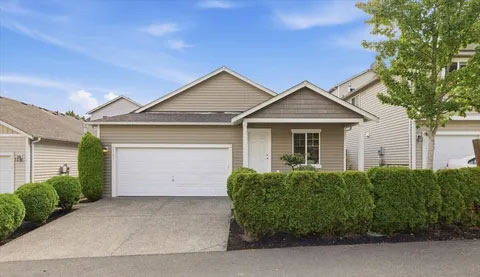
Many people are contemplating whether to continue renting or buy a home in Lynnwood, located north of Seattle.
Lynnwood has steadily gained attention over the past few years due to its accessibility to northern Seattle.
The current median home value is about $760,000, and a 2-bedroom rental costs around $2,117 per month. Compared to a few years ago, this can be seen as a gradual adjustment.
First, let's look at the Price-to-Rent Ratio, which is the ratio of home prices to annual rent.
If this ratio exceeds 21, it is generally interpreted as favorable for renting.
When converted to monthly costs, the difference becomes clearer. Based on a 20% down payment and a 30-year fixed mortgage at 6.75%, the principal and interest amount to about $3,944 per month.
Compared to the rent of $2,117, there is a monthly difference of about $2,535.
When viewed over a year, this is not a small amount, and whether one can comfortably manage this difference is the first hurdle.
Additionally, the down payment of about $152,000 needs to be considered separately.
When factoring in the opportunity cost of what could have been earned by investing this money elsewhere, it seems realistic to approach the current purchase decision with caution.
Property taxes and insurance rates can vary depending on the state, county, and address.
If you are moving from another state, do not estimate based on the standards of your previous location; instead, recalculate based on the actual address.
During periods of high interest rates, there has been a trend of enduring renting before transitioning to purchasing during rate adjustments.
Similar patterns were observed in the late 1990s and mid-2000s.
Those who waited for a favorable combination of interest rates and prices often achieved better outcomes.
However, there is no guarantee that the same trend will repeat. It's worth remembering that waiting is also a choice.
When placed alongside its surroundings, Lynnwood's position becomes clear.
It is nearly at the same level as nearby Seattle (about 29.9) and somewhat higher than Federal Way (26.8). This means that living in the suburbs does not necessarily equate to significantly lower prices.
As a commuting area to Seattle with a good reputation for schools, it appears to carry a premium. Families looking to move based on school districts should verify the assigned schools for the specific address before purchasing, as school boundaries can change.
Investors looking to purchase for rental income may interpret the same numbers differently.
It is challenging to cover a monthly payment of $4,652 with a rent of $2,117, making it difficult to expect profits without price appreciation.
Before making a decision, asking yourself a few questions can help clarify your thoughts.
How many years do you plan to live in this neighborhood? Can you manage a monthly difference of about $2,535 without disrupting your living expenses? Will you have emergency funds left after making the down payment?
If your stay is short, such as if your child is graduating soon or if there is a possibility of moving, it may be safer to continue renting.
On the other hand, if you plan to settle in this area for a long time and have the capacity for a down payment, preparing to purchase a home for stability is also worth considering. Ultimately, how long you intend to stay will determine the answer.
If you are certain about a long-term home, make preparations in advance, but be sure to check the latest market prices and interest rates right before signing the contract.
 Porynix
 LatteDreamer





 crystalx |

 compass |

 forward |

 harvest |









 Raccoon Ramen Night |

 ovelion |
 Something is popping in the situation |

 lumix88 |

 quiet river |
 Top |
 DOCTOR MED |
 Mia Flori |
 zorvik79 |
 There Are Such Things in the World |
 liquid asset |
 Banana |
 nova nova |
 Cahty Chung |
 NFL Forever |
 denvik37 |
 Choco Choco Star |
 Entering Art Directly |
 Mini Mee |
 Exciting chichichi |
 My Circle |
 Fun Flex Life |
 dermoon |
 Starbucks Reserve Roastery Closure |