

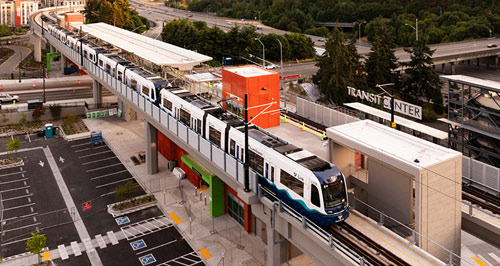
If you are a Korean family considering a move to Lynnwood, the transportation conditions will be one of your first considerations.
Just like school districts and housing prices, the commuting routes significantly affect overall life satisfaction.
Recently, inquiries about this area have increased, particularly regarding access to I-5 and the situation following the opening of the Lynnwood Link Extension.
Whether buying or renting, having a convenient daily commute is essential for long-term satisfaction.
I-5 runs vertically through Lynnwood, serving as a key route connecting Seattle and Everett.
However, traffic congestion during rush hours can be quite severe. Southbound towards Seattle experiences heavy traffic between 7 AM and 9 AM, while northbound towards Everett sees congestion from 3:30 PM to 6 PM.
If you are a commuter who must travel this route daily, it may be worth reconsidering your work hours.
Traffic planning data also confirms that travel times in this area can vary greatly.
It is not uncommon for a 30-minute trip to extend to an hour when traffic is heavy. Although there are HOV lanes, finding a carpool partner can be challenging.
That said, there aren't many viable alternatives to avoid this route.
SR-99 is an alternative route that runs parallel to I-5.
While it combines highway segments and urban arterials, making it slower than I-5, it can be effectively used as a detour during congestion.
Drivers in the area often alternate between the two roads based on the situation.
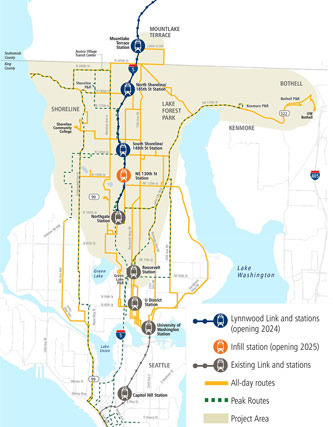
The most significant change is the opening of the Lynnwood Link Extension on August 30, 2024.
This new 8.5-mile segment includes new stations at Lynnwood, Mountlake Terrace, and Shoreline, following a route near I-5.
The introduction of a transportation option that operates independently of road congestion is a significant development.
Operated as part of the Sound Transit 1 Line, it allows travel from Lynnwood City Center station to downtown Seattle without transfers.
Depending on conditions, travel times may vary, but the predictability is much higher compared to commuting via I-5. The fare is around $3.
The availability of a transportation option that does not factor in congestion reduces one variable in the daily life of residents in this area.
More residents are choosing to leave their cars behind and commute via subway, which also alleviates parking concerns in the city. If the station is within walking or biking distance, reducing the number of vehicles to one is a realistic option to consider. Locations that meet these criteria are worth noting not only for actual living but also for future rental demand.
On the bus side, the Lynnwood Transit Center serves as a hub. Community Transit and Sound Transit routes converge here, connecting to Seattle, Everett, and Bellevue. While it is still insufficient for car-free living, the range of areas accessible by public transportation has noticeably expanded since the Link opened.
For families moving from other states to Lynnwood, it is essential to consider these transportation conditions as one of the criteria for choosing a home.
Locations closer to transit stations can reduce commuting burdens and may be advantageous in terms of long-term demand.
Conversely, if a location is overly dependent on the I-5 bottleneck, it introduces more variables to consider.
The transportation environment in Lynnwood is still evolving. Once the 2 Line is completed, connectivity in this area is expected to improve further.
If you are in the process of looking for a home, it is advisable to examine not only the current transportation network but also the upcoming expansion plans.
 LeeMuSong
 HeartMakers



 crystalx |

 compass |

 forward |
 harvest |









 Raccoon Ramen Night |
 ovelion |

 Something is popping in the situation |

 lumix88 |

 quiet river |
 Top |
 DOCTOR MED |
 Mia Flori |
 zorvik79 |
 There Are Such Things in the World |
 liquid asset |
 Banana |
 nova nova |
 Cahty Chung |
 NFL Forever |
 denvik37 |
 Choco Choco Star |
 Entering Art Directly |
 Mini Mee |
 Exciting chichichi |
 My Circle |
 Fun Flex Life |
 dermoon |
 Starbucks Reserve Roastery Closure |