
When I first came to Morgantown, I honestly didn't expect a city to be so close to nature.
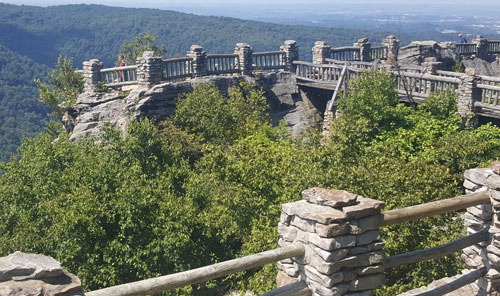
The strong image of a college town made me think only of the campus and students, but just a short drive away, a completely different landscape unfolded. As I grew weary of my busy life, I found a few places to catch my breath, and the first place that captured my heart was Coopers Rock State Forest.
I still remember the first time I stood at the overlook. Looking down at the endless expanse of forest and gorge, I thought, "I can't believe such a place is right next to Morgantown." It takes less than 20 minutes by car, yet the noise of the city disappears, leaving only the sounds of the wind and birds. In that moment, instead of taking out my phone to snap a picture, I found myself just staring blankly at the scenery for a long time.
This place is not just a simple park. With over 12,000 acres of vast forest and more than 50 miles of trails, it is one of West Virginia's premier natural attractions, complete with rock climbing areas and gorge overlooks. In spring, the fresh green forest is invigorating, and in summer, the dense foliage provides a cool shade. When autumn arrives, the entire mountain is painted in red and yellow leaves, and I finally understand why people drive for hours to visit this place. In winter, you can easily spot people enjoying cross-country skiing along the snow-covered forest paths.
The more I walk here, the more I feel that time has layered upon this place. Most of the picnic shelters and stone structures scattered throughout the forest were built by the Civilian Conservation Corps (CCC) from the late 1930s to the early 1940s. The old chestnut buildings still quietly stand in nature and are registered as a National Historic Landmark. Perhaps that's why it feels more like a space where history and nature meet rather than just a place to exercise.
Coopers Rock Lake, located within the forest, is also wonderful. Each season, trout are released, attracting many fishing enthusiasts, and in autumn, photographers set up their tripods early in the morning. The scenery that spreads across the lake when sunlight filters through the trees is beyond what can be captured in a photo.
Another must-visit is Chestnut Ridge Park. This area, connected to Coopers Rock, combines to create a massive natural space of over 16,000 acres. There are plenty of activities to enjoy year-round, including hiking, camping, bird watching, fishing, and winter skiing. On weekends, you can easily see families setting up tents and leisurely spending time, and watching that scene makes me feel relaxed as well.
Nature is also close to the urban area. The WVU Core Arboretum is a forest open to anyone for a stroll without an entrance fee, showcasing over 80 species of trees and various plants that change with the seasons. The paths are easy to navigate, making it a great spot for morning walks or light exercise. Mylan Park is a mixed-use space with sports facilities and green areas, while the WV Botanic Garden and Mason-Dixon Park are also quiet places to take a break.
Interestingly, in Morgantown, there's no need to travel specifically to see nature. You can take a short walk on the forest trails before work and forget the city at the gorge overlook with just a short drive on the weekend. This is how nature seeps into everyday life.
The reason I have come to like Morgantown more over time, which I initially thought of as a "quiet college town," is right here. Even without flashy tourist attractions, the nearby forests provide a place to relax, and the same location shows completely different expressions with each changing season. The saying that the longer you live somewhere, the more you understand it fits perfectly. The greatest charm of Morgantown seems to lie in the ease of being able to park your car and walk into the woods at any time.
 AnaMom
 McDonalPoo








 fortbliss |
 Folding Instructions |
 yentra |
 Cali M Law Group |
 quanta7 |
 Gomex Korea |
 silver |
 Oz's Wow Company |
 Thunderbird |
  manchester |
  constant |
  Leapfrog Move |
  vibranto |
  Tora Tora |
  yellowbutter |
  Dolly |
  US Embassy |
  NYC saladbar |
  Finding Superfoods |
  lightyear |
  song bang |
  vexomo |
  Indiana Jones |
  meloncat |
  novapixel |
  mortrix |
  Esther 1983 |
  Moscow Kim |