

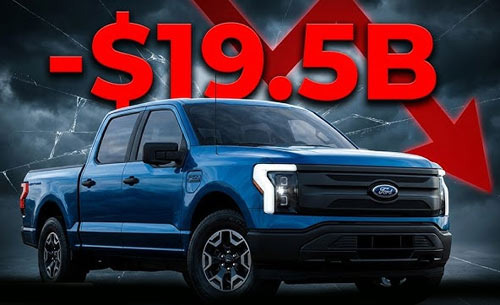
Are American Electric Vehicle Companies Losing Their Edge? Why is Tesla Holding Strong While Others Retreat?
In the early 2020s, the atmosphere in the American automotive industry was that "if it's not electric, there's no future."
Ford, GM, Stellantis, and other traditional powerhouses were quick to announce plans for electric vehicle investments worth hundreds of billions of dollars.
The US government also expanded the market by offering tax credits of up to $7,500. As you know, the $7,500 subsidy has been halted, and now there's chaos.
In fact, US electric vehicle sales surged over 60%, from about 490,000 units in 2021 to over 800,000 units in 2022.
At that time, experts analyzed that the electric vehicle market had entered the so-called 'S-curve' phase of explosive growth.
However, just 2-3 years later, the market's trajectory is flowing in a completely different direction than expected.
Major Automakers' Electric Vehicle Projects Come to a Standstill
American automakers are withdrawing or indefinitely postponing the ambitious electric vehicle projects they once pursued.
The most dramatic change has been seen at Ford. Ford had shown confidence in developing a large electric SUV aimed at achieving 350 miles (about 563 km) on a single charge.
However, after repeatedly delaying its launch, they ultimately scrapped the entire development project.
Ford's CFO John Lawler acknowledged the painful reality, stating, "We will not produce electric vehicles that do not generate profit."
The F-150 Lightning, once called 'the pride of American electric pickups,' has also drastically reduced production and shifted to a defensive stance.
In fact, Ford recorded a staggering loss of about $5 billion (approximately 6.8 trillion won) in its electric vehicle division alone in 2024.
GM is facing a similar situation. They have delayed the launch schedule for Buick's first electric SUV, and the highly-rated Chevrolet brand's commercial electric van 'BrightDrop' has halted production and officially declared discontinuation due to declining demand and reduced subsidies.
Volvo has begun to slow its transition to electric vehicles in the US, and Stellantis has adjusted plans for the Charger EV and Ram pickup EV.
The joint development model for an electric sedan that Honda and Nissan were planning for the US market has also fallen through.
Why Did the Booming Market Suddenly Cool Off?
There are clear reasons for the retreat of traditional automakers.
The end of the early adopter market and the 'chasm': The initial electric vehicle market was led by early adopters excited about new technology.
However, as it transitioned to the mainstream consumer market, it hit barriers.
Insufficient charging infrastructure, drastic reductions in driving range during cold winters, high insurance premiums, and battery replacement costs are factors that make consumers hesitant to open their wallets.
While the prices of battery raw materials are stabilizing, the large batteries used in the SUVs and pickup trucks favored by American consumers remain too expensive.
As vehicle prices soar, consumers are unwilling to pay that much, leading manufacturers into a bizarre structure where they incur significant losses with every car sold.
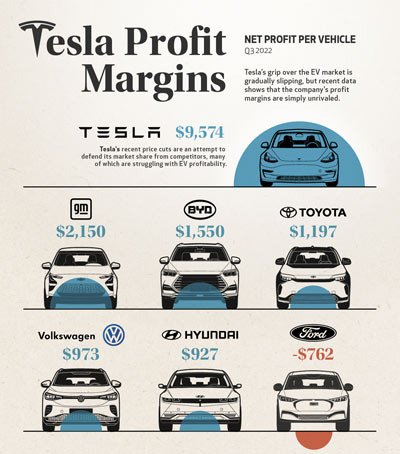
Why is Tesla Surviving While Others Are Falling?
Even in the same market environment, Tesla is holding strong. There are structural differences at play.
Different design and ecosystem from the start: Unlike traditional companies that add batteries to existing internal combustion engine platforms, Tesla started with a 'dedicated electric vehicle platform.'
They have also established an ecosystem with their own battery technology, unique OTA (over-the-air) software updates, and a dedicated charging network called 'Supercharger' that connects across the US.
Traditional automakers face overlapping costs for factory equipment, parts supply chains, and labor as they operate internal combustion, hybrid, and electric vehicle plants simultaneously during this transitional period.
In contrast, Tesla, which only produces electric vehicles, has drastically reduced production costs by adopting techniques like giga-casting (integral casting).
This is a key reason why Tesla can lead aggressive price-cutting strategies and still survive.
Another variable in the global market is China.
Chinese electric vehicle companies are rapidly encroaching on the global market with strong support from their government and an overwhelming low-cost battery supply chain.
Although the US market is protected by high tariff barriers, outside of that, in global markets like Europe, Southeast Asia, and South America, competition with Chinese companies is becoming increasingly challenging.
Ultimately, the current actions of the American automotive industry should not be seen as 'completely giving up on electric vehicles,' but rather as entering a phase of 'speed adjustment' for realistic survival.
The era of simply producing and selling as much as possible is over. Automakers are expanding their hybrid (HEV) and plug-in hybrid (PHEV) lineups to secure immediate cash flow while restructuring electric vehicle investments to focus on profitability.
The electric vehicle revolution will not stop, but the number of winners who will reach the finish line smiling is expected to be much smaller than initially anticipated.
 RapidCore84
 MagicGarden83







 coloradoman |
 Montgomery Mom |
 GOGO SING |
 Hajiwon Blog Hair Salon |
 tartbear |
 Weekend Movie Blog |
 Beauty, Health, Lifestyle Blog |
 Superman Cat Blog |
 Awesome Blog |
  novapixel |
  mortrix |
  ollege Mom |
  Esther 1983 |
  Arizona AZ Cowboy |
  fortbliss |
  Moscow Kim |
  My Two Way |
  toastyfox |
  FLORIDA Acus |
  tracker |
  TONTON COFFEE |
  sunrise |
  ultron78 |
  uplifted |
  Folding Instructions |
  same same life |
  USA Hyundai Kia |
  morvex37 |
  BOL SA RAM |