
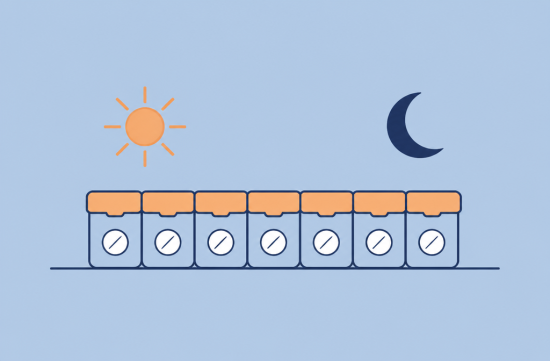
Last weekend, while I was putting apples in my shopping cart, a friend suddenly asked me whether it's better to take blood pressure medication in the morning or at night.
She heard somewhere that taking it at night is better for the heart, but the hospital she goes to told her to take it in the morning.
I felt like I had heard something about it too, but I couldn't give a clear answer. So, when I got home, I brewed a warm cup of tea and started looking it up one by one.
To cut to the chase, the large studies conducted so far are saying almost the same thing. There was no significant difference in the risk of heart disease or stroke whether taken in the morning or at night.
So where did the suggestion to take it at night come from? It started with the Hygia study from Spain published in the European Heart Journal in 2019.
This study involved 19,084 participants and reported that the risk of cardiovascular events was 45% lower in the group that took their medication at night. Just looking at the numbers, it sounds really appealing. As this result spread, the idea of taking it at night circulated for a while.
However, this study faced a lot of controversy right after it was published. There were criticisms that the effect was too large to be believable, and questions were raised about the study design and reporting methods.
The journal even expressed concerns. As a result, studies were conducted in other countries to verify the findings with more participants. Ultimately, this question led to large experiments over several years.
The first was the TIME study in the UK. Published in The Lancet in 2022, it divided 21,104 adults taking blood pressure medication into morning and evening groups.
The morning group took their medication between 6 AM and 10 AM, while the evening group took it between 8 PM and midnight. They looked at cardiovascular mortality, myocardial infarction, and stroke.
The results showed 3.4% for the evening group and 3.7% for the morning group. That's a 0.3 percentage point difference, but it wasn't statistically significant. In simple terms, it could be considered a coincidence.
Since this was a result of observing over twenty thousand people for several years, I found it quite credible. The researchers' conclusion was straightforward: there are fewer side effects, and you can take it at a time that is convenient for you.
The second study was the BedMed study in Canada, published in the Journal of the American Medical Association (JAMA) in May 2025.
This study gathered 3,357 participants from primary care settings in Canada and divided them into groups taking their medication at night and in the morning. It was a positive aspect that local hospital doctors directly recruited the patients. The average age of participants was 67, and more than half were women.
During the median follow-up period of 4.6 years, the rates of death or hospitalization for cardiovascular disease were 2.3 per 100 person-years for the night group and 2.4 for the morning group. Again, there was no difference.
In the end, both large studies from the UK and Canada provided similar answers. The significant effect reported in the Hygia study was not confirmed elsewhere.
Interestingly, there was a difference in nighttime blood pressure. Those who took their medication at night had significantly lower systolic blood pressure overnight.
However, this did not lead to a reduction in actual heart events. It made me realize that blood pressure numbers and actual outcomes don't always move together.
There was also the BedMed-Frail study published alongside it, which targeted frail elderly individuals in nursing homes, and it also found no differences based on timing.
In terms of safety, there wasn't much to worry about. In the TIME study, the evening group actually had slightly fewer falls.
However, one noticeable thing was that the group taking medication at night had a lower adherence rate compared to the morning group.
This seems to be the most realistic point. Many nights, we get tired and just fall asleep on the couch. I often forget to take my supplements a few times a week before bed.
So the key is not what time it is, but rather taking it consistently at the same time every day. I find this conclusion quite comforting.
However, there are considerations depending on the type of medication. If a medication contains a diuretic and is taken at night, it can cause you to wake up to use the bathroom.
Conversely, if someone feels dizzy taking it in the morning, it might be better to switch the timing. These factors really vary from person to person and medication to medication. So, one should be cautious about blindly following research results.
If you want to change the timing, be sure to consult with a doctor or pharmacist instead of deciding on your own. This is especially true for medications taken multiple times a day.
A few days later, I conveyed this to my friend when I saw her again at the market. I told her that if she's already taking it well in the morning, there's no need to change it. She smiled and said she felt relieved to hear that.
If it were me, I would place my pillbox next to the coffee maker. By attaching the task of taking medication to a daily habit, the chances of forgetting it decrease significantly. Having a weekly pill organizer can also be quite helpful.
Whether you take blood pressure medication in the morning or at night is fine. The best time is ultimately when I can remember to take it every day.
 ChocoBuddy
 SilverField77


 fruitflash |

 Anjollinya Blog |

 United States Army |

 premium |

 The Emperor Must Grow |

 lattepop |


 romeo JU |

 maryland park |


 strawberry |
 US Regional Information Local News |
 USA Business News |
 Blondee |
 E whisper |
 Potato House |
 freshmint |
 Ansaso |
 Golado |
 babybay |
 honeycom |
 French Macarons |
 Exploring American Life Information |
 Sunshine Blog |
 Community Cross |
 Sayonara H |
 What can make money? |
 Information Search LifeMAN |
 morvex37 |
 neontrail |