
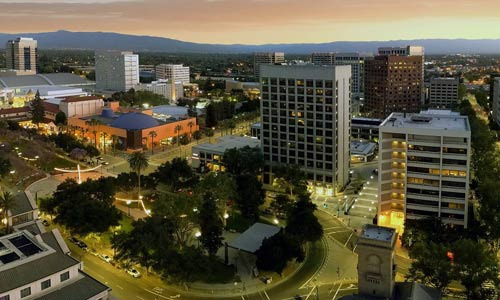
When talking to those considering a move to San Jose, there's a common question that comes up.
"The salary seems good, but can our family really live here?" I completely understand that sentiment. A quick internet search shows that San Jose has a high average salary, but when you factor in housing prices and living costs, the calculations can get complicated.
According to the U.S. Census ACS data, the median household income in San Jose is about $145,000 per year. This is nearly double the national median household income. Just looking at the numbers, one might think, "Wow, this is a city where people earn a lot of money." However, there's an important reason for this. San Jose is at the heart of Silicon Valley.
Global IT companies like Apple, Google, NVIDIA, Cisco, and Adobe are all located in this area. Software engineers, AI researchers, and semiconductor developers often earn not just $150,000, but many exceed $200,000 to $300,000. These high-income earners significantly raise the average and median incomes.
Conversely, those working in restaurants, hotels, retail, and service industries often earn much less. Therefore, seeing the median income of $145,000 might lead to the misconception that everyone in San Jose earns that much.
The biggest concern is, of course, housing prices. To buy a single-family home in San Jose, you typically need to budget around $1.3 million to $1.6 million. In popular areas like Willow Glen or Almaden Valley, homes often exceed $2 million. Condos are somewhat cheaper, but you should still expect to pay around $600,000 to $900,000.
So even with a salary of $140,000 to $150,000, buying a home is not easy. When you factor in mortgage payments, property taxes, and insurance, the burden can be significant. Locally, it's common to hear, "Salaries are high, but buying a home is tough."
On the other hand, those starting with rentals have a bit more flexibility. A one-bedroom apartment typically costs between $2,500 and $3,200 per month, while a two-bedroom unit ranges from $3,000 to $4,000. While this is still a considerable expense, dual-income families often manage to cover living costs while saving.
To reduce housing costs, many Korean families live in nearby cities like Cupertino, Milpitas, Santa Clara, and Fremont, commuting to San Jose. This allows them to save on rent, even if it means a longer commute.
The biggest advantage of San Jose is undoubtedly the job market. Even during economic downturns, Silicon Valley continues to generate new technologies and industries. Although there were layoffs at major IT companies in 2022 and 2023, the AI and semiconductor sectors are rebounding, and the job market is gradually recovering. Thus, it is still considered one of the most competitive cities in the U.S. in the long term.
It's also a relatively convenient city for Koreans to live in. With H-Mart, Korean restaurants, hospitals, churches, and various Korean businesses well-established, newcomers find it easier to adapt. It's also easy to find real estate agents or accountants who can provide services in Korean.
Ultimately, San Jose is a city where high income and high living costs go hand in hand. While salaries are among the highest in the U.S., housing prices and living expenses are also substantial. Therefore, before deciding to move, it's important to consider not just the salary but also rent or mortgage, education costs for children, and overall living expenses.
However, for those with stable jobs who want to grow their careers in the long term, San Jose is definitely a city worth considering. The initial settling costs can be daunting, but the opportunity to enjoy good jobs, educational environments, and a diverse Korean community is certainly a significant advantage. Ultimately, what matters is not how much others earn, but creating a realistic plan that fits our family's income and expenditure structure.
 SAMESAME
 OrangeMan







 cheesepup |
 breezem |
 yentra |
 virex |
 vexon87 |
 Western US Medical Student Association |
 DOCTOR MED |

 Koreab Date |
 good thinking |
  nixon |
  mini hometown |
  Gleeee |
  MacMorningBlog |
  ASURA |
  Elastico |
  shaket |
  vionoo |
  chocolate |
  Whisper |
  Star Voyager |
  InDiGo |
  Rocky Mountains |
  Whoever It Is, I Don't Know |
  Why Not Me |
  Plastic Rose |
  Rice Shop Uncle BLOG |
  Victory 1988 |
  Gook Rule |