
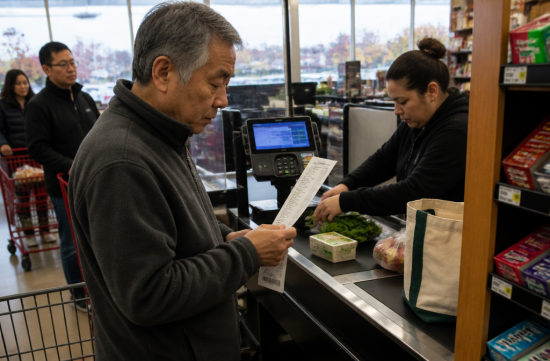
Early in the morning, I stopped by the local grocery store and bought some tofu, spinach, and a few apples. As I looked down at the receipt, I noticed that the tax line was still there.
I had clearly heard the news that Illinois had eliminated the grocery tax starting in January this year. My mind wavered for a moment, but I took my time to find out the reasons one by one.
First, let's clarify the facts from the state government. Illinois confirmed Public Act 103-0781 with the governor's signature in August 2024, and stopped collecting the 1% grocery tax at the state level starting January 1, 2026.
Many people miss an important point here. This 1% was not originally money that remained in the state treasury.
While the state collected it, the structure was such that the money was returned to the city or town where the goods were sold. So, if the state withdraws, the one that ultimately suffers is the budget of local governments.
Therefore, the law also opened a way to fill that gap. It allowed cities and counties to impose their own 1% grocery tax through ordinances without a referendum.
According to the Illinois Department of Revenue, there was also a deadline set. Places that enacted ordinances by October 1, 2025, could implement them starting January 1, 2026, and those that enacted them by April 1, 2026, could start on July 1.
The results leaned more to one side than expected. According to Capitol News Illinois, 656 municipalities passed their own grocery tax ordinances, which is just over half of all municipalities in the state.
Arlington Heights is one of them. The village board passed the 1% local grocery tax by a vote of 6 to 3 during a meeting on August 18, 2025.
The explanation from the village was simple. The village's 1% would replace the state's disappearing 1%, so the tax rate on grocery baskets would not change.
The village staff estimated that giving up this tax would mean losing $1.3 million from the general fund each year. That's not a small amount.
At the time, village officials said that without this revenue, property tax assessments might have to be raised by 8.25%. It was a balancing act between the grocery tax and the property tax bill.
Of course, there were opposing voices. One board member who opposed it argued that the grocery tax is a heavier burden on residents who are struggling financially and suggested raising the home rule sales tax instead.
Another board member proposed using the village's reserve fund, considering the rising costs of groceries, electricity, and insurance for residents.
A sunset provision that would automatically expire in two years and allow for a reevaluation was also put to a vote. This proposal was narrowly defeated by a vote of 5 to 4.
On the same day, the board also passed a new 5% tax on streaming subscriptions by a vote of 7 to 2. This is intended to cover the costs of operating a fifth ambulance year-round.
According to village estimates, this tax will collect $480,000 annually, while the cost for ambulance personnel is estimated at $1.12 million. If you subscribe to popular services with ads, it will cost an additional $41 a year, and for ad-free plans, it will be $61 more.
So, does only 1% apply to all food items? Not exactly. Soft drinks, candy, alcohol, and prepared foods that are ready to eat were never eligible for grocery tax benefits and are subject to the regular sales tax rate.
And there's another tax hidden on the receipt besides the village tax. The local transportation tax, used for public transportation funding in the Chicago area, also applies to groceries.
This transportation tax changed its name from RTA to NITA this year and increased by 0.25 percentage points starting August 1. Grocery items sold in Cook County went from 1.25% to 1.50%.
To summarize, the state's 1% tax has simply been renamed as the village's 1%, and the transportation tax has actually increased, meaning that the grocery tax on today's receipts is slightly higher than last year.
Honestly, I felt a bit disappointed at first. The word 'elimination' raised my expectations.
However, upon closer examination, it's not a story of being deceived. The state took credit, and the village chose a way to fill the budget gap.
There is, however, a lingering disappointment. The defeat of the sunset provision by a single vote means that residents lost the opportunity to reevaluate this in two years.
If you're curious about our local tax rates, you can check the Tax Rate Finder on the Illinois Department of Revenue website by entering your address. Some neighboring towns do not impose this tax, so it's more accurate to check directly with the address of the grocery store you shop at.
I personally wouldn't drive far to another grocery store just for a 1% difference. Instead, I would choose to pay attention to the village board's budget meetings.
There are many cases in the world where what you thought was gone has merely moved to a different spot. A single line on a receipt is one of them.
I put down my grocery basket and ponder over a cup of tea. The ability to see beyond the label and understand the content inside becomes more precious as I grow older.
 TiusMom
 ShowOff619

 juicylol |

 Mr Song Song |

 Way to easy |
 holy cow |

 Soy Angelino |

 Yugo Girl I'm So Hot |
 dreamer20 |

 Arlington house |



 Alright Twain |
 ssome |
 skykong |
 Shining Our Own World |
 gardener 007 |
 golfmaster |
 Nanana Nanana Nanana |
 Who's watching? |
 endone |
 RockStar |
 Casa Mia |
 You Only Live Once |
 Hardworking CPA |
 Joyce 77 |
 Runner Kim |
 My Town My Way Blog |
 My Miami Stories |
 Entip |
 Tony Park |
 Jean Claude Bundang Blog |
 DJ DC BLOG |